The Phantom Spring: Dismantling the Myth of the “Bengal Renaissance”
For over a century, the cultural memory of nineteenth- and twentieth-century Bengal has been wrapped in a shroud of romantic exceptionalism known as the “Bengal Renaissance.” Conjuring images of intellectual awakening, artistic brilliance, and radical social reform, the term is deployed to frame colonial-era Calcutta as the crucible where modern India first learned to think, question, and progress. Yet, when subjected to rigorous historical scrutiny, particularly through the lens of Max Weber’s insights on the Protestant work ethic as a structural and ethical prerequisite for modern development, this grand narrative begins to dissolve. A prominent local counter-argument often insists that modernity does not require Protestant ethics, boasting that Bengal could leap straight into an enlightened, secular age through native intellectual brilliance alone. However, this defensive claim collapses under the weight of history. The so-called Bengal Renaissance was not a sweeping, organic cultural revolution that transformed society from the ground up; rather, it was an insular, upper-caste phenomenon that mistook intellectual mimicry for true enlightenment, masking a profound socio-economic retreat behind a facade of high-minded rhetoric.
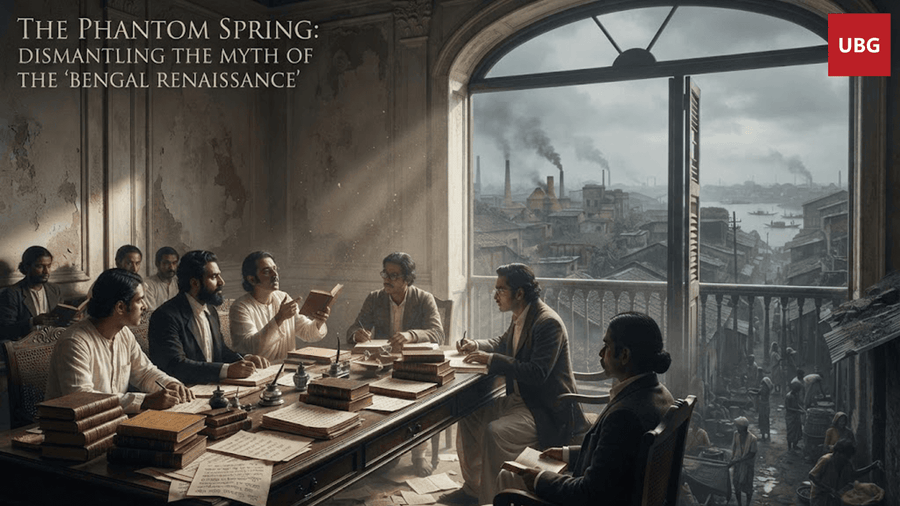
To understand the myth, one must first examine its geography and demographics. A genuine renaissance, such as the historical movement in Europe, fundamentally reorders the economic, structural, and cultural foundations of an entire civilization. In contrast, the Bengal Renaissance was almost exclusively confined to a microscopic sliver of society: the urban, upper-caste Hindu bhadralok (Brahmins, Kayasthas, and Vaidyas) centered around Calcutta. The vast majority of the population—the rural peasantry, the artisan classes, the lower castes, and the Muslim majority of Bengal—remained entirely untouched by the debates raging in Brahmo Samaj salons or colonial colleges. For them, the nineteenth century brought crushing agrarian exploitation, poverty, and eventually devastating famines, largely unmitigated by the poetic musings or philosophical treatises of Calcutta’s literary elite.
Furthermore, the social reforms frequently cited as crown jewels of this era, such as the abolition of sati, the push for widow remarriage, and the advocacy for female education, were defined by a deeply paternalistic character. These changes were rarely the result of broad-based, grassroots democratic movements; instead, they were negotiated through colonial legal channels by an elite eager to prove its “civilized” credentials to British masters. Women were educated, yes, but primarily to serve as refined, companionable wives for English-educated gentlemen within the domestic sphere (ghar), leaving the patriarchal foundations of the family structure fundamentally intact. The bhadralok sought reform only insofar as it did not threaten their high-caste social standing or disrupt their domestic comforts.
Perhaps the most glaring contradiction of the Bengal Renaissance lies in its absolute lack of economic impact. Those who claim that Bengal bypassed Protestant ethics and still achieved a valid modernity ignore the disastrous economic reality of that choice. Devoid of the inner-worldly asceticism, capital reinvestment, and industrious drive associated with the Protestant ethic, the movement generated zero economic transformation. The bhadralok steadfastly rejected commerce, manual labor, and industrial enterprise, viewing physical labor and trade through an aristocratic, caste-bound lens. Instead, they sought security as clerical intermediaries (babus), lawyers, and minor functionaries under the British Raj, or lived off the extraction of rent as absentee zamindars. A culture cannot undergo a true modernization when its intellectual vanguard relies entirely on a parasitic economic model. Writing poetry, translating European texts, and engaging in theological debates became a substitute for real-world action, functioning as a coping mechanism that allowed the elite to feel culturally superior to their colonial rulers even as they remained politically subjugated by them.
Compounding this intellectual isolation was the elite’s complicity in a deeply reactionary political narrative. To secure their place in the colonial administrative sun, the bhadralok eagerly co-opted British historiography, buying into the manufactured myth of a pre-colonial “dark age” under the Mughals and Nawabs. By painting Bengal’s sophisticated, cosmopolitan Persianate past as a period of tyranny and backwardness, the Hindu intelligentsia justified British conquest and validated their own collaboration. In doing so, they blinded themselves to the administrative, commercial, and legal genius of the very society that preceded them, cutting themselves off from indigenous traditions of statecraft and wealth generation. When demographic realities shifted in the twentieth century and separate electorates gave voice to the marginalized Muslim majority, the bhadralok, having built their identity on intellectual snobbery and colonial patronage rather than broad social solidarity, found their dominance hollowed out from beneath them.
Ultimately, the “Bengal Renaissance” was a phantom spring. It produced brilliant literature, sharp legal minds, and eloquent critics, but it built no industrial infrastructure, generated no sustainable economic engine, and failed to uplift the masses it claimed to enlighten. The assertion that Bengal could achieve a functional modernity without an ethical foundation of productive labor, thrift, and structural transformation is proven false by its legacy of economic stagnation and social fracture. By substituting poetic rhetoric for productive labor and colonial mimicry for true structural transformation, the bhadralok created an intellectual bubble that eventually burst. What remains is not the memory of a renaissance, but a cautionary tale of an elite that spent its golden age debating in the parlor while the house burned down around them.