Post-Call Survey (PCS): The “Protagorean” Illusion of the Customer
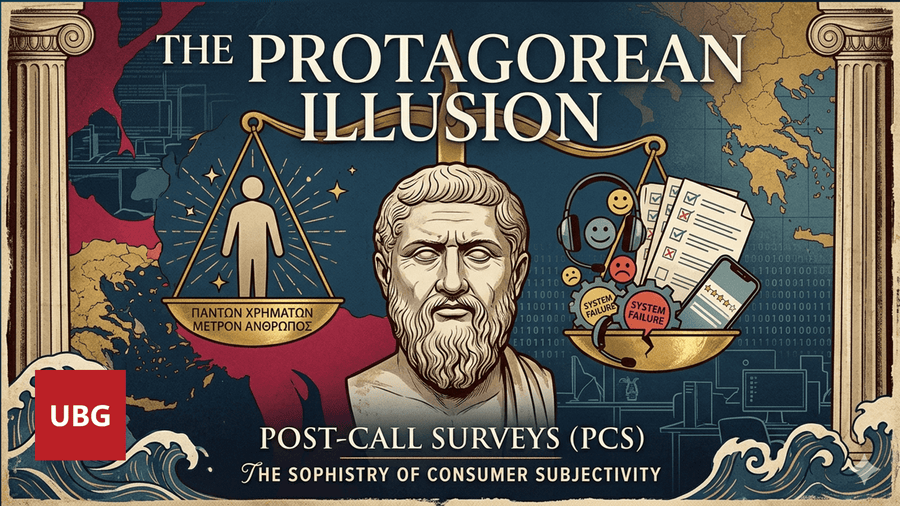
The Sophistry of Subjectivity
The philosopher Protagoras of Abdera (c. 485–415 BCE) serves as the foundational lens for understanding a crisis now endemic in the corporate world. His famous maxim, “Man is the measure of all things” (πάντων χρημάτων μέτρον ἄνθρωπος), posited that individual perception creates individual reality. In the contemporary workplace, this ancient philosophical stance has evolved from an ontological theory into a calculated instrument of control, transforming the standard Post-Call Survey (PCS) from a tool of quality assurance into a mechanism of mass displacement.
The Rise of the Customer-Arbiter
This transition marks a critical shift in power dynamics: management has effectively rebranded the customer from a participant in a service transaction into an empowered arbiter of truth. Within this Protagorean model, the customer is conditioned to believe that their personal satisfaction—regardless of the objective facts of an interaction—constitutes the singular reality of corporate performance. When customers rate an agent, they are performing a Protagorean mandate, operating under the assumption that their subjective emotional state, whether rooted in logic or irrationality, holds the authority to define success. Every interaction is thus converted into a trial where the “truth” is whatever the customer declares it to be.
Camouflaging Systemic Failure
The inherent sophistry of this system lies in its ability to camouflage the mechanical failures of the corporation behind the ego of the consumer. Blindsided by the perceived sovereignty of their role, the customer remains largely detached from the systemic rot—the broken software, the impossible queue times, and the contradictory internal policies—that actually dictate the outcome of a call. By design, the corporation avoids resolving these architectural flaws. Instead, the burden of quality is offloaded onto the customer’s sense of self-importance. The company provides the customer with the currency of validation, inviting them to act as a judge, while the front-line employee is forced to navigate an environment where “performance” is no longer defined by objective accuracy, but by the total submission to the customer’s subjective ego.
The Theater of Illusion and Accountability
Ultimately, the PCS acts as the primary tool in this theater of illusion. It allows the corporation to bypass internal accountability by outsourcing the discipline of its workforce to the consumer. Because the customer is the “measure,” any failure of the system—which the employee cannot control—is localized onto the worker, who is subsequently punished for failing to preserve the customer’s satisfaction. In this paradigm, the organization is not interested in genuine improvement; it is interested in maintaining a system that protects the architecture of failure. By keeping the consumer in the role of the “king” who rates their subjects, the organization ensures that the spotlight never shifts toward the systemic contradictions that would require significant capital and authentic leadership to rectify.