The Great Inversion: Why the Modern “Open Mind” is a Sectarian Prison
In contemporary discourse, the “open mind” is presented as the ultimate intellectual virtue—a neutral, transparent window through which we view a pluralistic world. However, a deeper philosophical autopsy reveals a paradox: the modern concept of open-mindedness is not a window, but a closed sectarian system. It is an epistemological enclosure that is structurally incapable of acknowledging objective reality, making it a prisoner to the very subjectivity it claims to liberate.
The Cartesian Prison: Subjectivity as a Padded Cell
The modern “open mind” stands on the foundation of the Cartesian Cogito (I think, therefore I am). This “inward turn” shifted the locus of truth from the external Logos (the objective order of nature) to the internal subject. When truth is grounded solely in the “I,” the mind becomes a closed loop. We no longer “open” our minds to discover a Natural Law that exists independently of us; instead, we “open” them only to rearrange our own internal representations. This is the first wall of the prison: the belief that reality is something the subject certifies, rather than something the subject obeys.
The Semantic Mask and the Death of Natural Law
To maintain this subjective enclosure, the modern mind adopts a dogmatic constructivism. Influenced by postmodern thought, it treats Natural Law not as a discovery of the cosmos, but as a “social construct.” By reducing Truth to Semantics, the modern mind performs a clever sleight of hand. It can criticize any objective claim by labeling it a “language game” or a “power narrative.” This creates a “one-way” skepticism: the modern mind uses deconstruction as a hammer to break everyone else’s foundations while treating its own foundation—the autonomous Subject—as a sacred, untouchable site.
The most sectarian feature of this system is its aggressive move toward Cultural Hegemony. While philosophers like Plato or Aristotle sought a universal truth that all could share, the modern “open mind” (informed by Marx and Gramsci) views all ideas through the lens of power dynamics. The result is a Sectarian Filter:
- The “In-Group”: Those who agree that truth is subjective and socially constructed are labeled “open-minded.”
- The “Out-Group”: Those who believe in objective moral or natural orders are labeled “dogmatic” or “intolerant.”
In this sectarian framework, “neutrality” is weaponized. It isn’t a space for all ideas; it is a gatekeeping mechanism that excludes any idea “too large” or “too certain” to fit within the subjective prison. It is, in essence, a Fascism of the Subject, demanding total social conformity to a specific brand of relativism.
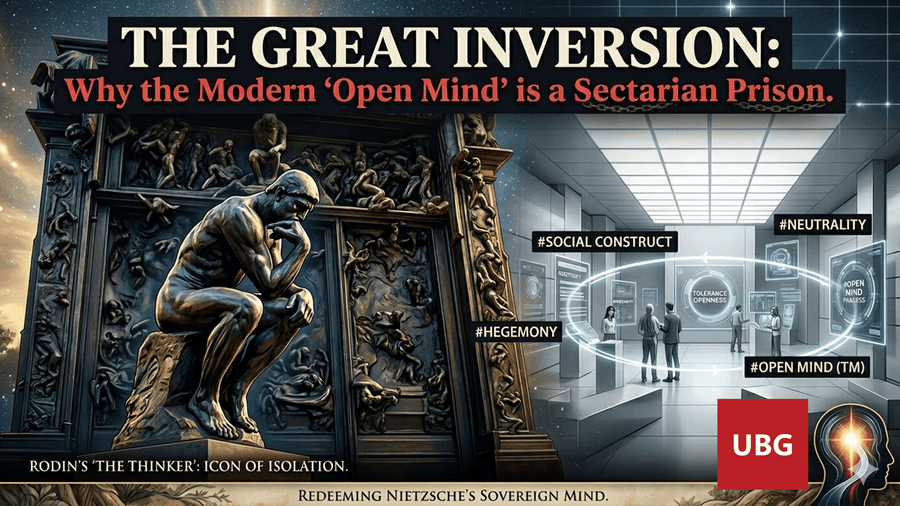
It is a profound irony that the modern “open-minded” sect has adopted Rodin’s The Thinker as its mascot. While they use the image to signal a posture of neutral, free inquiry, the statue’s original placement atop The Gates of Hell reveals the truth of this thesis: he is the ultimate icon of the Cartesian prisoner. He does not look up toward the Logos or the objective heavens; instead, he is hunched in a torturous inward turn, staring down at a chaotic world of his own making. By using this image, the modern sect performs a sectarian projection, claiming a monopoly on “thought” while remaining trapped in a closed loop of subjectivity. They have turned a symbol of the agonizing struggle for self-mastery into a logo for a Gramscian hegemony, masquerading their refusal to acknowledge any truth outside the self as a form of intellectual heroism.
The Nietzschean Exit: Mastery Over the Soul
The true alternative to this sectarian prison is found in a corrected understanding of Friedrich Nietzsche. Unlike the modern sect, which seeks hegemony over others, Nietzsche’s “open mind” is centered on the mastery of one’s own soul.For Nietzsche, the “Will to Power” was never about enslaving the neighbor or controlling the social narrative; it was an internal, aristocratic project.
- Internal Sovereignty: The sovereign individual is “open” because they are strong enough to interrogate their own drives and create their own values.
- The Pathos of Distance: Crucially, the master of his own soul has no desire to infringe on the sovereignty of others. He does not seek “hegemony” because he does not need the “herd” to validate his internal reality.
From Sieve to Sovereign
The modern “open mind” is a sieve—it is open because it is empty, a transit point for collective slogans and “sectarian” word-games. It is a prisoner because it cannot exist without the constant validation of the social collective.The truly open mind—the mind of the Sovereign Individual—is one that has mastered its own interior castle. It recognizes that “mastering the discourse” is a poor substitute for “mastering the self.” By refusing to project its morality onto others and refusing to be “constructed” by the collective, the sovereign mind breaks the sectarian loop. It realizes that the only way to truly open the mind is to first build a door around the soul, protecting its internal mastery from the infringing “neutrality” of the modern herd.