The “Parallel State”: How Bangladesh Became the NGO Capital of the World
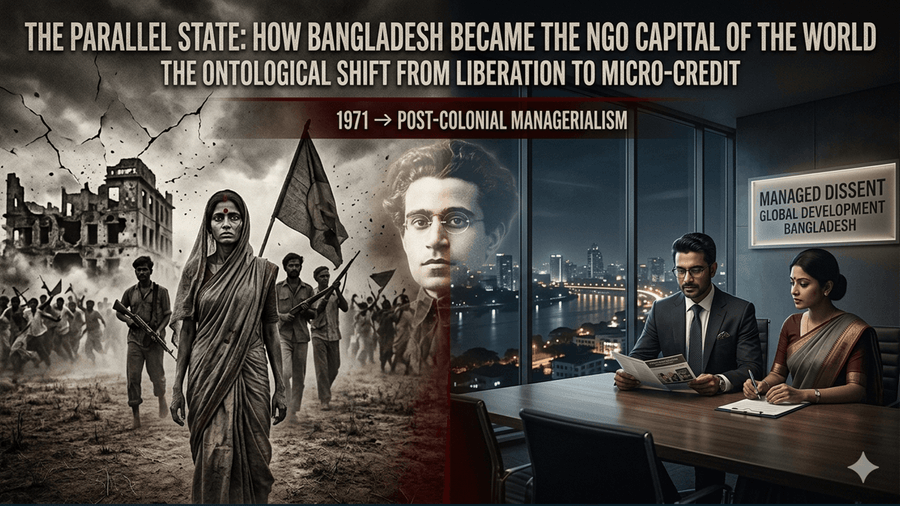
The emergence of Bangladesh as the global headquarters for the “Third Sector” is not merely a story of humanitarian success; it is a profound ontological re-engineering of a post-colonial nation. In the smoke and rubble of the 1971 Liberation War, the infant Bangladeshi state was physically decimated and administratively hollow. This vacuum provided the opening for a “War of Position” that fundamentally altered the “being” of the Bangladeshi citizen. Figures who might have otherwise been the architects of a traditional socialist state instead pivoted to the NGO sector, founding behemoths like BRAC and Grameen Bank. These were not merely charities; they were the seeds of a parallel state that substituted the revolutionary “militant” with the “manager.”
The Ontological Shift: From Citizen to “Project Participant”
In the early 1970s, the “being” of the Bangladeshi was defined by Collective Liberation—a revolutionary identity rooted in a struggle for sovereign, structural change. However, as the state struggled to provide basic order, the NGO emerged as the primary Ordering Principle of life. This initiated a shift from political existence to economic utility. Through the mechanism of micro-finance, the fundamental nature of the subaltern was edited: the subject was no longer a political actor seeking state-led justice, but a “Project Participant.” The revolutionary demand for land reform was replaced by the ontological burden of Debt, turning the potential insurgent into a “Micro-Entrepreneur” whose daily reality is governed by credit cycles rather than class consciousness.
The Rise of the Shadow Sovereign
As these organizations grew, they created a Shadow Sovereignty that bypassed the traditional state bureaucracy. In rural Bangladesh, the state became a distant, often spectral abstraction, while the NGO became the tangible reality—the provider of schools, healthcare, legal arbitration, and even identity. This created a paradoxical “Passive Revolution.” By utilizing Gramscian “Cultural Hegemony,” NGOs successfully challenged traditional patriarchal and religious structures, maintaining their radical, progressive credentials. Yet, this “empowerment” was carefully decoupled from the seizure of state power. The village became a laboratory for managed dissent, where social indicators like literacy and fertility were improved precisely to ensure the underlying global financial architecture remained undisturbed by actual revolt.
The Professionalized Ghost
By the 1990s, this process birthed a new class of “NGO Tycoons.” These are the “Organic Intellectuals” of the professionalized Left—highly educated, globalized elites who exist in a state of permanent mediation. They speak the dialect of “Social Justice” to Western donors while translating the grievances of the subaltern into “Capacity Building” projects. This represents the final destination of the “Long March through the Institutions.” In the Bangladeshi context, the firebrand was not defeated by the sword; they were ontologically transformed into the Global Consultant.
Today, Bangladesh stands as the definitive case study for the institutionalized ghost of Gramsci. The revolutionary fire of the independence era was not extinguished; it was absorbed, budgeted, and managed. The struggle for power was traded for the management of poverty, proving that the most effective way to contain a revolution is to give it an executive board, a global platform, and a seat at the donor’s table.