The Architecture of Happiness: Eudaimonia vs. Nirvana
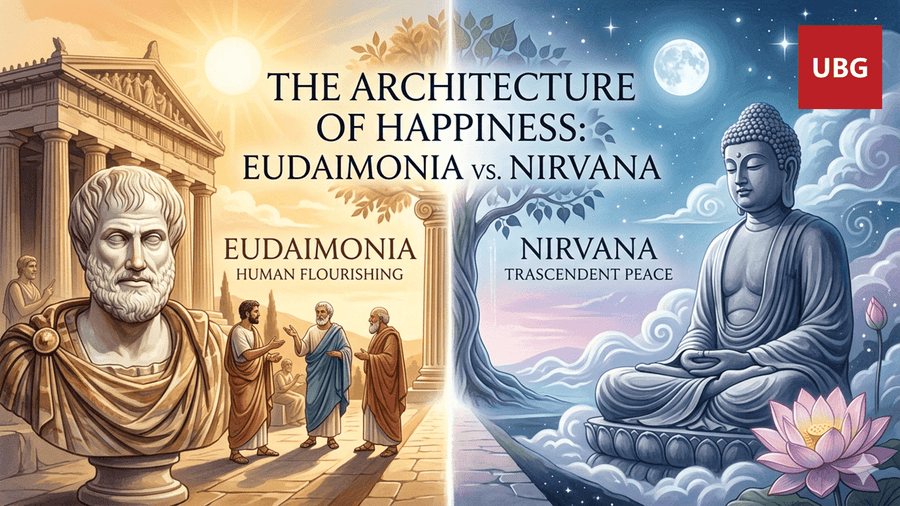
At first glance, the ancient Greek philosopher Aristotle and the Buddha seem to be walking toward the same mountain from opposite sides of the world. Both identified that human life, as typically lived, is characterized by a restless dissatisfaction—what the Buddha called Dukkha and what Aristotle saw as a life lived “at the whim of chance.” To solve this, they proposed two of history’s most influential concepts of “The Good Life”: Eudaimonia and Nirvana. While they share a structural interest in human potential, their definitions of what a “perfected” life looks like offer two distinct blueprints for the soul.
The nature of these goals reveals a fundamental difference in how we view the “self.” Eudaimonia, often mistranslated as simple happiness, is better understood as “human flourishing” or “doing and living well.” For Aristotle, it is an active state—the result of a life lived in accordance with reason and virtue (arete). It is the perfection of the human person. In contrast, Nirvana literally means “to extinguish” or “to blow out,” specifically referring to the fires of greed, hatred, and delusion. While Eudaimonia is about the fulfillment and active exercise of the self’s highest faculties, Nirvana is often described as the realization of “non-self” (Anatta), where the boundaries of the individual ego are dissolved into a state of liberation.
The role of the physical world also marks a sharp divide between the two traditions. Aristotle’s “virtue ethics” is grounded in a certain level of realism; he argued that while virtue is central, one cannot be truly eudaimon if they are starving, friendless, or suffering extreme misfortune. You need a certain amount of “external goods”—health, wealth, and community—to provide the stage upon which virtue can be practiced. Buddhism, however, views dependence on these external goods as the very root of suffering. Because all external things are impermanent (Anicca), tethering your happiness to them is seen as a logical error. Nirvana is found by turning inward and severing the “thirst” or craving for external stability entirely.
Furthermore, the “energy” of these two states differs in its approach to action. Eudaimonia is essentially a verb; it is the “active exercise of the soul’s faculties.” A person is flourishing when they are engaging in their community, practicing courage in difficulty, or contemplating philosophy. It is a life of high-functioning engagement. Nirvana, conversely, is characterized by the peace of cessation. It is the end of the “becoming” process. While an enlightened person still acts in the world, their actions are often described as “trackless”—they perform duties with total presence but without the sticky attachment to results that creates further cycles of unrest.
Despite these differences, both paths are paved with the same bricks: The Middle Way. Aristotle’s Golden Mean, where virtue is the midpoint between the extremes of excess and deficiency, mirrors the Buddha’s Middle Way, which rejects both indulgence and harsh self-mortification. Both systems suggest that the “Good Life” requires a rejection of radical imbalance. Whether one aims for the flourishing activity of the Greek citizen or the transcendent peace of the Buddhist sage, the journey begins with the disciplined cultivation of character and the mastery of one’s own desires. Ultimately, both traditions agree that happiness is not a stroke of luck, but a skill to be practiced.