The Ontological Void of the “Gentleman”
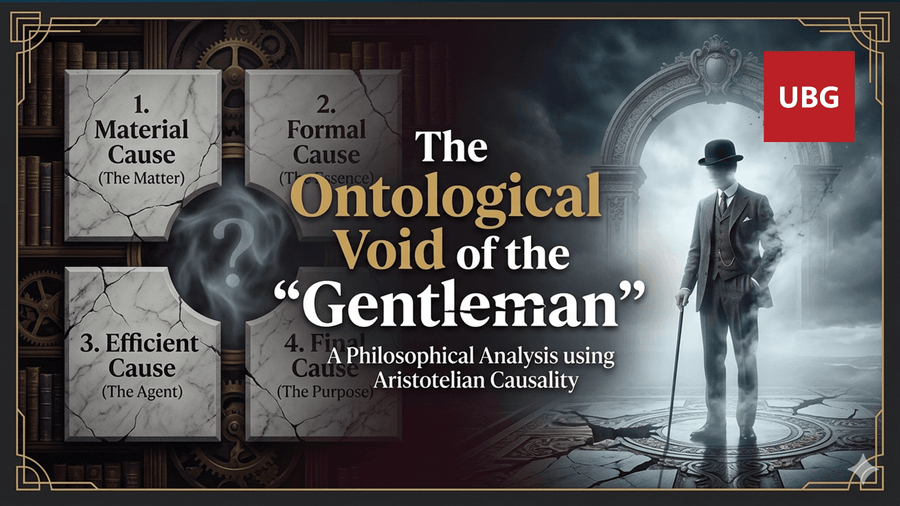
Ontology is the study of being—the investigation into what makes a thing truly “real.” In the classical tradition, defining an entity wasn’t just about choosing the right words; it was about identifying the fundamental forces that brought that entity into existence. Aristotle provided the most enduring roadmap for this investigation through his Four Causes. However, as society evolves, many of our most cherished terms begin to lose their grounding. When we subject the term “gentleman” to Aristotelian scrutiny today, we find that it no longer points to a stable reality. Instead, we discover an ontological void: a linguistic container that remains in our vocabulary even though its substance has evaporated. To determine if a “gentleman” truly exists in a metaphysical sense, we must pass it through the four filters of causality:
The Aristotelian Framework
Material Cause (The Matter)
What is it made of? For a gentleman, the material is a human being. Yet, “humanity” is the material for all people, from saints to criminals. The material alone cannot justify the existence of a “gentleman.”
Formal Cause (The Pattern)
What is its definition or essence? This is where the “gentleman” begins to fail. Historically, the “form” was rigid: a man of noble birth who did not work for a living. Today, the “form” is an amorphous cloud of “good manners” and “vague kindness.” Without a fixed form, the ontology of the object collapses.
Efficient Cause (The Agency)
How did it come to be? In the past, the efficient cause was a combination of lineage, education, and social investiture. If everyone can be a gentleman simply by deciding to be one, the efficient cause becomes so diluted that it loses its power to create a distinct class of being.
Final Cause (The Purpose/Telos)
What is its function? The original telos of a gentleman was to serve as a bridge between the monarchy and the peasantry, providing local leadership and moral example. In a modern, democratic, and digital world, this specific function has vanished.
The Ontological Void
The argument for an ontological void rests on the fact that the “Gentleman” is now a term without a Formal or Final cause. In Aristotelian terms, if a thing has no clear definition (Form) and no specific purpose (Finality), it does not truly “exist” as a distinct category of being. An ontological void occurs when a word continues to circulate in a language despite the fact that the reality it once described has been dismantled. The “gentleman” has become a “floating signifier.” We use the word to describe someone who holds a door open or speaks softly, but these are mere accidents of behavior, not a fundamental change in the person’s being. We are essentially pointing at a vacuum and using an old map to describe a landscape that has been leveled.
Conclusion
By applying Aristotle’s causality, we see that the “gentleman” is no longer a type of being, but a linguistic relic. The material remains (the human), but the form and purpose have dissolved. What we are left with is a void—a space in our social grammar where a solid identity used to sit, now filled only by the echoes of a defunct social hierarchy. To call someone a gentleman today is not to describe what they are, but to gesture toward a ghost of what we used to value.