The Ghost of Gramsci in the Post-Colonial World: From Comrades to Consultants
The Metamorphosis of Latin American Resistance
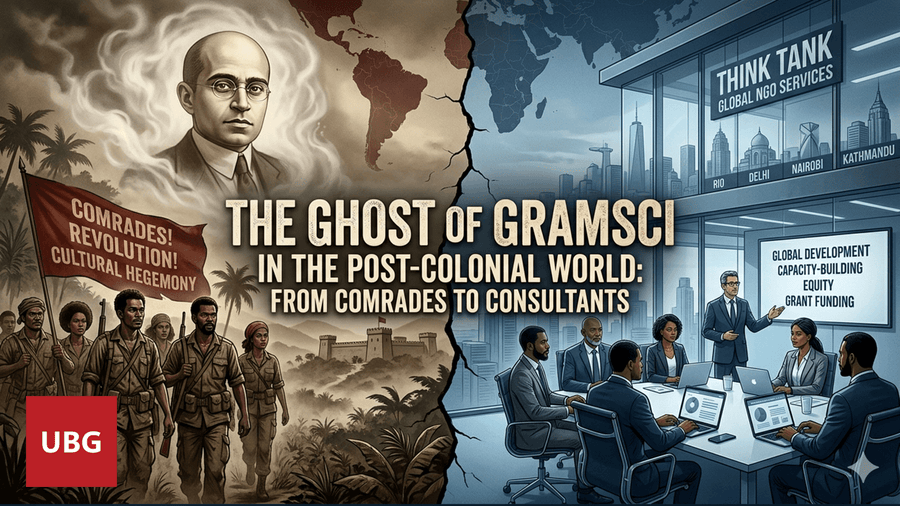
The “ghost” of Marxism-Leninism, particularly in its Gramscian iteration, has undergone a profound metamorphosis across the post-colonial world, shifting from the militant revolutionary cell to the air-conditioned offices of the NGO sector. In Latin America, the transition is perhaps most visible. The region, once defined by the Cold War’s armed insurgencies and “Dependency Theory,” has seen its radical energy diverted into a sophisticated network of “Civil Society” organizations. Former revolutionaries have largely abandoned the jungle for the think tank, utilizing Gramscian concepts of “Cultural Hegemony” to challenge traditional structures like the Church and the patriarchal family. By focusing on indigenous rights and environmental justice, these leaders maintain their radical credentials while receiving substantial funding from European and North American foundations, effectively “NGO-izing” the resistance.
Africa and the “Third Sector” Hegemony
In Sub-Saharan Africa, the collapse of the Soviet Union left a vacuum of patronage that was swiftly filled by the “Third Sector.” African intellectuals, long steeped in the anti-colonial Marxism of figures like Frantz Fanon, have pivoted toward a Gramscian “War of Position” within the international development framework. These “NGO Tycoons” have become a shadow state, providing essential services while simultaneously critiquing “Western Neo-colonialism.” This creates a bizarre paradox where the very intellectuals who use Marxist frameworks to analyze the continent’s underdevelopment are financially dependent on the Western global financial architecture. The result is a professionalized activism that seeks to reform the system from within rather than overthrowing it, turning the revolutionary drive into a series of “capacity-building” projects.
The Metamorphosis of Latin American Resistance
The “ghost” of Marxism-Leninism, particularly in its Gramscian iteration, has undergone a profound metamorphosis across the post-colonial world, shifting from the militant revolutionary cell to the air-conditioned offices of the NGO sector. In Latin America, the transition is perhaps most visible. The region, once defined by the Cold War’s armed insurgencies and “Dependency Theory,” has seen its radical energy diverted into a sophisticated network of “Civil Society” organizations. Former revolutionaries have largely abandoned the jungle for the think tank, utilizing Gramscian concepts of “Cultural Hegemony” to challenge traditional structures like the Church and the patriarchal family. By focusing on indigenous rights and environmental justice, these leaders maintain their radical credentials while receiving substantial funding from European and North American foundations, effectively “NGO-izing” the resistance.
Africa and the “Third Sector” Hegemony
In Sub-Saharan Africa, the collapse of the Soviet Union left a vacuum of patronage that was swiftly filled by the “Third Sector.” African intellectuals, long steeped in the anti-colonial Marxism of figures like Frantz Fanon, have pivoted toward a Gramscian “War of Position” within the international development framework. These “NGO Tycoons” have become a shadow state, providing essential services while simultaneously critiquing “Western Neo-colonialism.” This creates a bizarre paradox where the very intellectuals who use Marxist frameworks to analyze the continent’s underdevelopment are financially dependent on the Western global financial architecture. The result is a professionalized activism that seeks to reform the system from within rather than overthrowing it, turning the revolutionary drive into a series of “capacity-building” projects.
The Indian Intellectual and the Subaltern Narrative
India presents perhaps the most academically refined version of this phenomenon. The Indian intellectual landscape was deeply shaped by the “Subaltern Studies” group, which utilized Gramsci’s ideas to give voice to the marginalized castes and tribes outside the traditional power structure. Today, this intellectual legacy is carried forward by a high-profile class of activists and academics who operate within a massive NGO ecosystem. While the language remains fiercely anti-capitalist and anti-hegemonic, the funding often originates from the world’s most powerful philanthropic bodies. These Indian “Organic Intellectuals” are often members of an urban, globalized elite who bridge the gap between the rural “subaltern” and the international donor class, translating grassroots grievances into the specialized dialect of “Social Justice” and “Equity.”
The Rise of the NGO Tycoon in Nepal, Bangladesh, and Pakistan
In the specific contexts of Nepal, Bangladesh, and Pakistan, the transition has produced a unique class of “Marxist-turned-NGO Tycoons.” In Nepal, former Maoist commanders and student radicals have traded their fatigues for suits, heading organizations that manage everything from peace-building to gender advocacy. In Bangladesh, the radical secularism of the 1970s has been absorbed by “development empires” that function as parallel governments. In Pakistan, the marginalized Left has retreated into the legal and academic spheres, utilizing international grants to challenge the military establishment’s hegemony. In all three nations, the revolutionary impulse has been “captured”—converted into a career path that offers a salary, a global platform, and a seat at the donor’s table.
The Institutionalized Ghost
Ultimately, these common denominators reveal a “ghost” that has been institutionalized. The former Marxist firebrands have become the new managers of social discontent. Across the Global South, the “Long March through the Institutions” has reached its destination: the university chair and the NGO executive board. By controlling the cultural narrative and the “Common Sense” of the progressive movement, these NGO tycoons ensure that radical thought survives in name, even as it is decoupled from the actual seizure of economic or state power. The ghost of Gramsci haunts the post-colonial world not as a specter of revolution, but as a professional consultant for managed social change.