The Rent-a-Mob Economy: Mass Action as Elite Rivalry
We live in a political culture that loves the romance of the street. Turn on the news or open social media and you will see breathless reports of massive groundswells, spontaneous public outcries, and organic uprisings. We are constantly sold the comforting illusion that history moves from the bottom up, that the masses, moved by shared ideological zeal, rise up to demand justice, reshape nations, and humble the powerful.
History tells a more consistent and less flattering story.
When the retroactive mythology is stripped away, mass action is rarely an expression of autonomous popular political agency. It is raw material: bodies, noise, and visual legitimacy that organized minorities purchase, subsidize, or direct. From the developing world, where political bosses rent crowds for a day’s wage, to the classic revolutions that replaced one set of rulers with another, the masses have almost never been the authors of political change. They supply the kinetic energy. Someone else supplies the steering, the logistics, the narrative, and the post-victory settlement.
Popular grievances are usually real. Hunger, inflation, arbitrary violence, landlessness, status collapse, or simple exhaustion generate genuine anger and a willingness to take risks. That fuel has existed since the earliest records. What has not existed, as a durable pattern, is independent mass authorship of outcomes. What the masses have possessed is the perception of agency. That perception is manufactured and maintained by the intellectual apparatus elites control or contest: temples and priestly classes, court scribes, clerical hierarchies, universities, party schools, newspapers, NGOs, foundations, and today’s academic departments and platforms. These institutions supply the vocabulary (“the people,” “justice,” “the nation,” “democracy,” “liberation”) that converts private misery into a public story in which the crowd is the protagonist. The story maps onto real pain. The mapping, the framing, the slogans, the funding, and the safe houses come from an organized minority.
In much of the Global South, where daily wages are low and the informal labor market offers little safety net, parties, oligarchs, and regional bosses treat the public as cheap political muscle. The person who accepts a small stipend, a transport voucher, and a meal is not demonstrating revolutionary fervor; he or she is working a day-labor job. Elite buyers purchase crowd size to manufacture the appearance of overwhelming support, to intimidate opponents, to pressure courts, or to impress foreign media and NGOs. The crowd does not write the message. It is the backdrop purchased by the person holding the microphone and the checkbook.
The Rent-a-Mob Economy
The same dynamic appears, in milder form, wherever organizations face grant-driven metrics or media incentives. Headcounts can be manufactured with stipends, buses, and logistics. The visual of “the people” becomes a deliverable. In wealthier countries the commercial version exists openly: firms supply hired participants for rallies, hearings, and demonstrations. Compensation is modest; the principle is identical. Volume can be bought when organic turnout is insufficient or inconvenient.
The Historical Pattern
This is not a modern pathology of weak states. It is the ordinary mechanics of political succession.
Raw grievances create the potential for movement. An organized minority (disgruntled intellectuals, military officers, merchants, party cadres, or clerical networks) supplies the direction. The masses act as the battering ram that cracks the old order. Once the gates fall, the same organizational capacity that directed the storm reasserts control. The ancient regime is replaced by a rival faction of elites. Flags and faces change; the structural relationship between the organized few and the disorganized many does not.
The classic cases (the Bastille, Petrograd, Havana, Beijing) follow the sequence. Material precarity provided the spark. Disciplined minorities provided the program, the coordination, and the monopoly of force afterward. Starving peasants or day laborers do not spontaneously organize cross-city uprisings, safe houses, printing presses, and post-victory constitutions on empty stomachs. Someone funds and steers the machinery. When the dust settles, the history books, written by the winners, convert a proxy struggle among elites into an epic of national or popular awakening.
The same pattern appears in the leaderless, social-media-coordinated waves of the 2010s. Initial energy was often genuine and decentralized. Durable institutional change was rare precisely because the movements lacked a cohesive organizational core capable of converting street pressure into lasting power. Rival elites, security services, or external actors filled the vacuum. Technology lowered coordination costs; it did not eliminate the decisive advantage of organization and narrative control.
The Perception of Agency
The academic and media infrastructure is not a neutral recorder of this process. It is one of its instruments. When universities, foundations, or journalism systematically privilege certain framings of grievance while marginalizing others, they perform the classic function of narrative control. Participants on the street experience their actions as self-directed. Strategic decisions (targets, non-negotiable demands, which factions are legitimized afterward) remain with those who control resources and organization. The result is the perception of mass authorship without the substance.
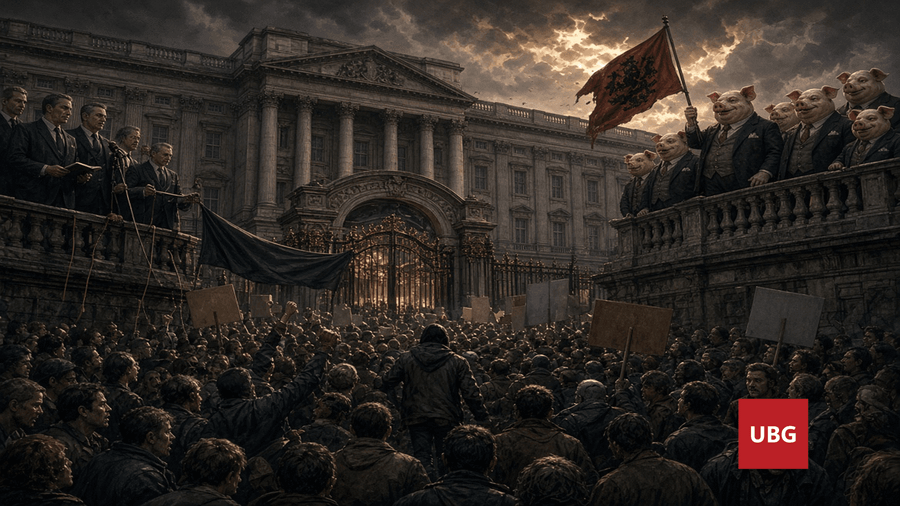
This is the blueprint Orwell dramatized in Animal Farm. Real suffering among the ordinary animals. A small organized minority supplies the ideology and the coordination. The old order is broken by mass energy. The minority converts temporary revolutionary authority into permanent hierarchy, rewrites the rules, and maintains the story that the arrangement is still “for the animals.” The mass continues to supply labor and legitimacy. The structural relationship persists.
Recognizing this is not a denial of suffering or of the kinetic power of crowds. It is a refusal to romanticize a system that commoditizes desperation and then launders the outcome as popular sovereignty. Until economic and organizational agency is widely distributed enough to make the masses something other than rentable raw material, the political game remains what it has long been: a contest among those who hold the checkbook, the printing press, and the organizational skeleton, using bodies they can mobilize for the afternoon. The farm changes hands. The relationship between the pigs and the other animals does not.