Pews to Cubicles: Why People Rebel Against Christianity Only to Bow Before Corporate Dogma
A common cultural critique often echoes through modern intellectual circles: Christianity only survived history because of an information monopoly. It was allegedly propped up by censorship, locked-down texts, and a priestly class that kept people in the dark while maintaining a sanitized narrative. Strip away that scaffolding, the argument claims, and the whole system collapses under the weight of open information.
The people who forward these arguments usually fancy themselves radical freethinkers. They believe they have outgrown the dogma of the past. But if you apply a little philosophical rigor, and look at the actual telos, meaning the ultimate purpose and outcome of what they are doing, a massive and glaring irony emerges.
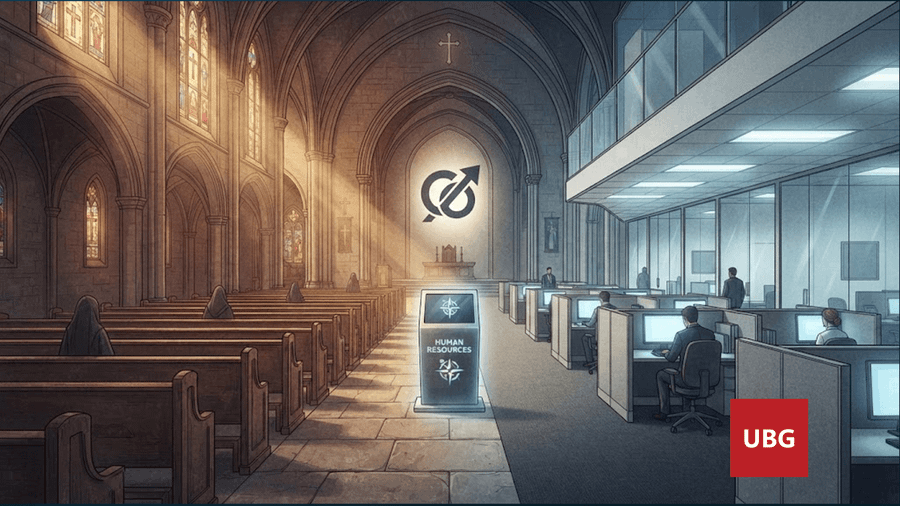
These critics haven’t escaped dogmatism, information control, or priestly hierarchies. They simply traded the church for the corporation, swapped out the theology for corporate policy, and bowed down to a new set of high priests in Human Resources.
Stealing the Fruit While Hating the Tree
The first major flaw in this modern critique is a profound historical amnesia. Critics love to attack traditional Christian frameworks while simultaneously championing values such as universal human dignity, equality, care for the weak, and empathy for the marginalized, all of which are distinctly Christian in their historical origin.
In the ancient pagan world, might made right, and the weak were largely left to fend for themselves. The radical rupture of Christianity introduced the idea that every individual possesses inherent worth. Today, secular culture takes this outcome entirely for granted. Yet, critics will use these very moral tools, forged in a theological furnace, to beat Christianity over the head, all while giving a free pass to other major traditions with identical historical roots. The double standard reveals that the target isn’t really about information monopolies or historical flaws. The real target is Western civilization and any remaining structure that stands outside state and corporate control.
The New Cathedral
When a society stops building cathedrals, it does not stop being religious. Human beings have an innate drive to organize their lives around a central moral authority, a system of orthodoxy, and a framework for redemption. When institutional religion recedes, that telos doesn’t vanish. It simply migrates.
Look closely at the modern corporate state, and you will find that the structures critics claim to hate about the church have been meticulously rebuilt in the office:
Original Sin to Bias Training
In a church, you acknowledge your fallen nature. In the modern corporate office, you undergo mandatory training sessions to acknowledge your systemic or personal complicity in cultural sins.
The Priesthood to Human Resources
Instead of medieval priests interpreting scripture, we now have HR departments and compliance officers acting as the moral arbiters of the workplace, managing speech codes, and ensuring ideological purity.
Heresy to Social Exile
Step outside the approved boundaries of modern corporate orthodoxies, and you face swift excommunication, whether through social ostracization or getting fired.
Indulgences to Virtue Signaling
Just as institutions once purchased moral absolution through penance, modern corporations buy public grace through ritualistic environmental, social, and governance statements and public campaigns.
A New Master, Not Freedom
When you break it all down, the critic’s fantasy of liberation is an illusion. They claim to despise the idea of a system built on controlled access to information and enforced orthodoxy. Yet, they willingly submit to tech monopolies, algorithmic control, and corporate HR departments that enforce compliance with a rigidity no medieval bishop could ever dream of achieving.
The ultimate irony is found in the telos. At least a cathedral pointed toward a transcendent, eternal purpose, meaning something higher than human politics or profit margins. The modern corporate cathedral has no such horizon. Its ultimate destination is liability mitigation, shareholder value, and absolute behavioral conformity.
The critics didn’t smash the machine. They simply replaced the cross with a corporate logo, put HR in the pulpit, and decided that obeying a CEO is progress while obeying a creed is darkness.