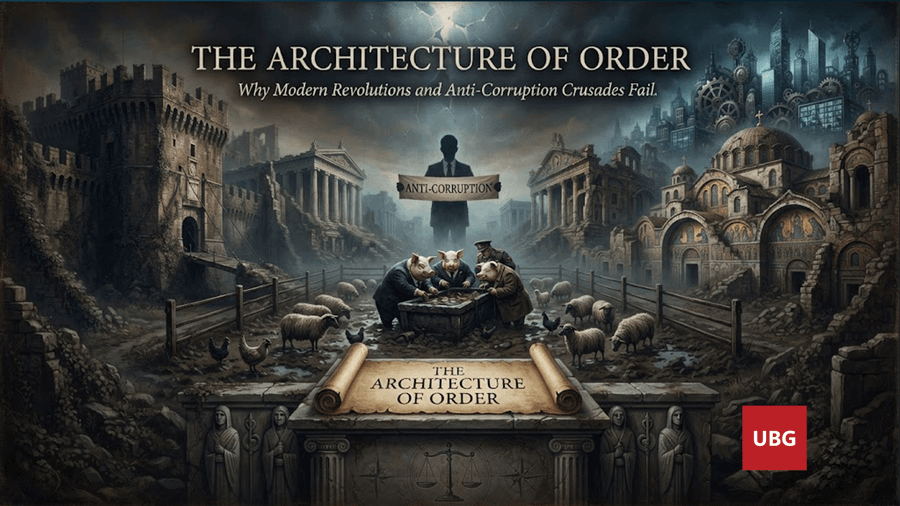
The Architecture of Order and the Animal Farm
To understand why modern geopolitical upheavals descend into chaos, and why anti-corruption crusades perpetually serve as PR tools for new tyrants, we have to look past the superficial headlines of the 24-hour news cycle. We have to strip away the language of democracy, insurrection, and reform and look at human history through its true, theological and structural roots.
At the core of this crisis is the descent of human civilization into what can be described as an animal farm, borrowing the famous political allegory coined by George Orwell. In this framework, an animal farm is a closed system originally designed to overthrow a tyrannical farmer in the name of equality and liberation for all the beasts. However, once the old master is driven out, a new ruling class among the animals, specifically the pigs, takes over the farmhouse. They slowly rewrite the rules, move into the human quarters, and establish a totalitarian hierarchy under the guise of ongoing reform. In an animal farm, revolutionary rhetoric is just noise used to manage the livestock while the new managerial elite gorges itself at the feeding trough.
Modern revolutions are rarely grass-roots bursts of human freedom. They are managed restructurings orchestrated by two timeless pillars: the ledger, representing corporate and financial interests, and the sword, representing the security and military apparatus. When these forces orchestrate regime change abroad, Western media labels it a democratic awakening. When the exact same populist energy breaches a Western capital, it is instantly branded an insurrection. The double standard exposes a simple truth: the rules only ever apply to the governed, never to the managers.
To understand why this systemic rot is permanent in the modern world, we must examine the original architecture of human governance, and how humanity broke it.
The Original Order: The Triad and the Temple Economy
In the traditional, ancient framework, human society was organized around a sacred triad:
- The King, wielding the temporal sword, bound by law, and acting as a physical administrator.
- The Priestly Caste and Sacred Order, providing spiritual intercession and moral boundaries, ensuring temporal power answered to a higher authority.
- The People, living within a stable, covenantal community regulated by a temple economy.
In a true temple economy, economic life, charity, and social welfare were sustained horizontally through voluntary tithes, endowments, and community-held trust grids. The altar was separate from the sword. The king could hold physical power, but he could not invent divine law or treat the community resources as his personal corporate balance sheet.
The Great Rupture: The Collapse of the Sacred-Temporal Balance
The historical collapse of this balance began when the boundary between the sacred and the temporal was violated, leading directly to the conditions that triggered the Protestant Reformation and the ultimate secularization of the West.
The Western Error (The Papal Fortress)
The Papacy abandoned its role as a spiritual altar and morphed into a worldly political state. By building physical fortresses, running banks, raising standing armies, and playing high-stakes European power politics, the church became a temporal kingdom. When the priesthood becomes a landlord with an army, it loses its prophetic voice. It cannot speak truth to power when it is the power. This deep corruption of the sacred center shattered the traditional moral canopy and paved the way for the secular ledger to take over.
The Eastern Error (Caesaropapism)
In the Byzantine model, the pendulum swung to the opposite extreme. The Emperor swallowed the altar, turning the church and its hierarchy into an administrative department of the imperial palace. The priesthood became civil servants on the state payroll.
The Trigger: The Reformation and the End of Divine Order
When the sacred authorities in the West transformed into secular monarchs behind fortress walls, and Eastern authorities became tools of the state, the foundational boundary between the altar and the sword was irrevocably broken. The sacred order had been absorbed by the temporal machine.
This collapse triggered the Protestant Reformation. Seeing the Papacy behaving as a worldly prince or an arm of the state, reformers sought to tear down this corrupt, institutional structure. However, the unintended consequence of breaking the old, hierarchical sacred canopy was not a restoration of the ancient temple balance. Instead, it created a vacuum of spiritual authority.
The vacuum left by the fracturing of the church was swiftly filled by the rise of the secular nation-state and the absolute dominance of the ledger. Divorced from any transcendent sacred law, the state became a law unto itself, and the economy became the new organizing principle of society.
The Myth of Technocratic Purity
Today, we live in the final stage of this process: the realization of a global animal farm where technocracy operates on the delusion that human greed and corruption can be engineered out of existence through regulations, compliance audits, and algorithms. But corruption is not a software bug, it is a reflection of fallen human nature and humanity’s original rebellion against divine order.
In an animal farm, where there is no higher moral law and no transcendent sacred canopy, looting the public treasury is not viewed as a moral crime. It is simply the natural behavior of beasts feeding at the trough. Modern anti-corruption rhetoric is nothing more than the noise made by new managers weaponizing compliance to purge rivals and centralize power.
Conclusion
Until modern society confronts its foundational, spiritual rebellion and re-establishes a true boundary between temporal power and higher moral law, every revolution will simply swap one set of managers for another. True order cannot be coded by technocrats or financed by central banks, it requires recognizing that power must always bow to a truth higher than the sword and the ledger.