The Pervasion of Dialectical Contradiction: From Politics to Private Life
In political discourse, dialectical contradiction—rooted in Hegelian and Marxist philosophy—serves as a strategic tool, where opposing forces are embraced and resolved to advance ideological goals. Practitioners often justify hypocrisy as a necessary “synthesis,” such as preaching equality while wielding authoritarian control. However, this mindset rarely confines itself to the public sphere. As observed in historical and contemporary figures, individuals who wield dialectical contradiction politically tend to entrench it in their private lives, leading to profound suffering for their nearest relations, mirroring the harm inflicted on outsiders.
At its core, dialectical thinking fosters a tolerance for inconsistency, viewing moral or ethical tensions not as flaws but as engines of progress. In politics, this manifests as leaders endorsing peace while sponsoring conflicts or advocating for the oppressed while suppressing dissent. Yet, this cognitive flexibility erodes personal accountability. When applied to intimate relationships, it justifies behaviors that prioritize self-interest or ideological purity over empathy and consistency. Nearest ones—spouses, children, and close kin—become unwitting participants in an unbalanced “dialectic,” where affection coexists with neglect, control with professed love, or sacrifice with exploitation.
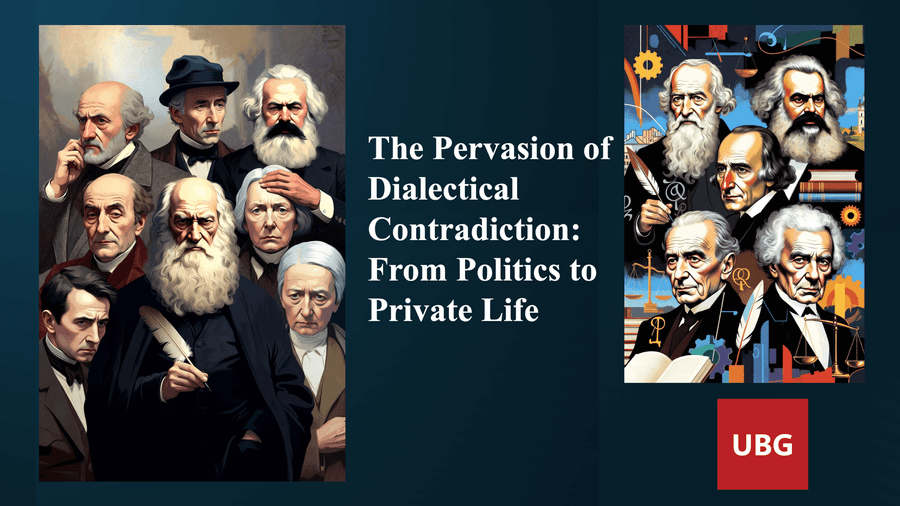
Historical examples abound. Jean-Jacques Rousseau, whose Émile championed compassionate child-rearing, abandoned his five children to a foundling hospital, rationalizing it as essential for his philosophical pursuits. Karl Marx, the architect of class struggle dialectics, imposed poverty and instability on his family, leading to the early deaths of four children and the suicides of two surviving daughters—contradicting his public calls for human solidarity. In more recent cases, prominent intellectuals like Jean-Paul Sartre and Simone de Beauvoir maintained an open relationship that masked emotional manipulation of partners and students, blending radical freedom with possessive dynamics.
This perversion extends to contemporary figures in politics and activism, where public personas of moral authority often conceal private tyrannies. The nearest suffer uniquely: unlike outsiders who can disengage, family members endure prolonged exposure, internalizing the contradictions as normalized dysfunction. Children may replicate the pattern, perpetuating intergenerational harm, while spouses face isolation or gaslighting under the guise of “necessary compromise.”
Ultimately, the entrenchment of dialectical contradiction in private life reveals its corrosive nature. What begins as a political expedient becomes a personal pathology, eroding trust and humanity in the most intimate spheres. To mitigate this, individuals must cultivate self-awareness and ethical consistency, recognizing that true progress demands harmony between public rhetoric and private conduct. Without it, the dialectic devolves into a cycle of suffering, indiscriminate in its victims.