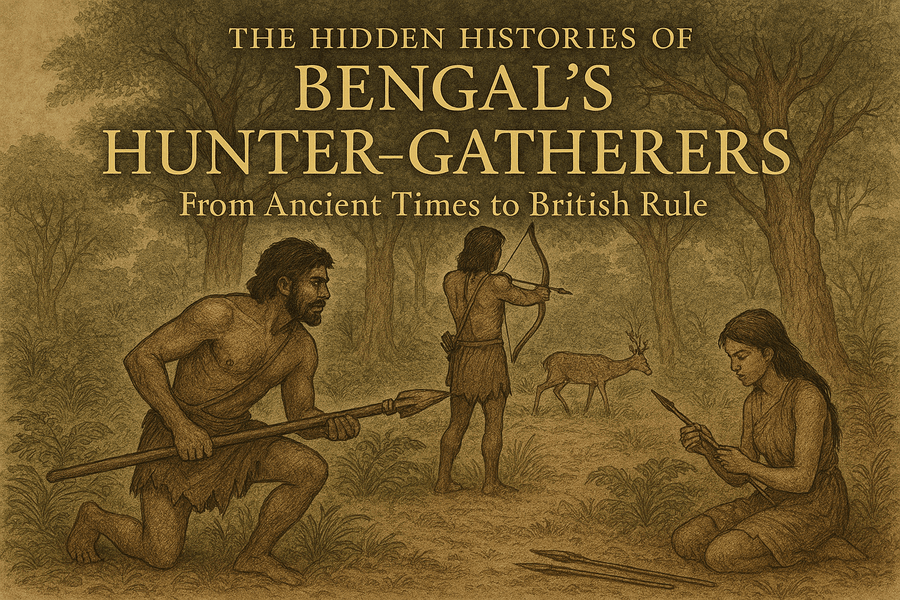
The Hidden Histories of Bengal’s Hunter-Gatherers: From Ancient Times to British Rule
The Ancient Era: Foundations of Foraging Societies
Bengal, encompassing the modern regions of West Bengal in India and Bangladesh, has long been celebrated for its agrarian heritage, urban centers, and cultural richness. Yet, beneath this narrative lies a largely understated story of hunter-gatherer societies that played a pivotal role in shaping the region’s demographic, cultural, and ecological landscape. This underrepresentation stems from historical biases, including nationalist doctrines that emphasize settled civilizations and Soviet-influenced propaganda that attributes societal ills primarily to colonial exploitation, often overlooking pre-colonial dynamics. In reality, hunter-gatherer populations in Bengal were far more extensive and influential than commonly acknowledged, persisting through millennia and interacting with incoming agrarian and religious forces. This article explores their history from the ancient era to the British colonial period, drawing on archaeological, historical, and ethnographic evidence, while incorporating insights from Richard M. Eaton’s seminal work, The Rise of Islam and the Bengal Frontier, 1204-1760, which illuminates their role in Bengal’s Islamization but leaves room for broader prehistoric and colonial contexts.
The Ancient Era: Foundations of Foraging Societies
Bengal’s human history begins in the prehistoric period, where hunter-gatherer communities dominated the landscape long before the advent of agriculture. Archaeological evidence from sites in the Bengal Delta reveals that by the second millennium BCE, the region was inhabited by diverse groups including Indo-Aryans, Tibeto-Burmans, Dravidians, and Austroasiatics, who migrated in waves and lived as foragers. These early inhabitants relied on the fertile yet challenging environment of river valleys, forests, and plains for sustenance, using stone tools characteristic of the Paleolithic and Mesolithic eras. The Mesolithic period marked a transition, with communities employing microlithic tools and semi-permanent settlements. Sites like those along the eastern fringe of the Chhotanagpur plateau and southwestern West Bengal show evidence of hunter-gatherers coexisting with early food producers around 10,000–8,000 BCE. Unlike the Indus Valley Civilization to the west, which emphasized urban planning, Bengal’s foragers adapted to a dynamic fluvial environment, where rivers like the Ganges and Brahmaputra shifted courses, fostering nomadic lifestyles. Estimates suggest that India’s hunter-gatherer population, including those in Bengal, accounted for about 25% of the global total in recent centuries—a figure five times that of North America and the Arctic combined—indicating their significant historical presence. Nationalist historiography, focused on Vedic and imperial narratives, has marginalized these groups, portraying them as “primitive” remnants rather than foundational elements. This bias, compounded by post-colonial emphases on anti-colonial struggles, has obscured how these foragers contributed to Bengal’s genetic and cultural diversity, blending with later migrants to form the region’s ethnic mosaic.
Transition to Agriculture and Early Kingdoms
By the Neolithic period, around the late second or early first millennium BCE, Bengal saw a gradual shift from foraging to farming, marked by rice cultivation and Black and Red Ware ceramics. However, hunter-gatherers did not vanish; they coexisted with and sometimes resisted agrarian expansion. Ancient texts and archaeology indicate that regions like the Bengal Delta were initially “outside the pale of human habitation,” infested with forests and wildlife, where foragers thrived. The arrival of Vedic settlers and the formation of Janapadas (kingdoms) like Pundra, Banga, and Gauda in ancient Bengal pushed many foragers to marginal areas, but their populations remained substantial.During the Mauryan and Gupta empires (c. 321 BCE–550 CE), Bengal was a peripheral yet vital region, with hunter-gatherers providing resources like timber, honey, and labor. The expansion of Buddhism and Hinduism further integrated some groups, but others maintained autonomy in forested frontiers. Eaton notes that these forest-dwelling communities were key to Bengal’s cultural assimilation, as incoming religions adapted to local practices. Yet, Soviet-trained historians in post-independence India often framed pre-colonial society as egalitarian, blaming colonial rule for all divisions, thus downplaying the internal hierarchies that marginalized foragers.
The Medieval Period: Islam, Frontiers, and Forager Conversions
The medieval era, particularly from the 13th century onward, saw profound changes with the arrival of Islam. Eaton’s The Rise of Islam and the Bengal Frontier argues that Bengal’s receptivity to Islam was tied to its eastern delta’s agrarian frontier, where hunter-gatherers and forest dwellers converted en masse as forests were cleared for rice farming. Unlike forced conversions elsewhere, this process was linked to economic incentives: Sufi pioneers and Mughal administrators facilitated land grants, integrating foragers into Islamic agrarian societies. By the 16th century, eastern Bengal’s Muslim population surged, transforming former foraging lands into productive paddy fields.Eaton emphasizes that pre-Turkish Bengal (before 1204) was a mosaic of indigenous groups, with Islam spreading not through coercion but via cultural and economic frontiers. Tribes like the Baiga, Asura, Garo, and others in Bengal Presidency enjoyed relative tranquility until Mughal times, but their extent was vast—far larger than nationalist accounts admit, which often romanticize a unified Hindu past. Propaganda portraying colonialism as the sole disruptor ignores how medieval expansions already displaced foragers, though Eaton’s work stops short of fully exploring pre-1204 dynamics.
The British Colonial Era: Exploitation and Marginalization
Under British rule (1757–1947), hunter-gatherers faced accelerated marginalization. The Permanent Settlement of 1793 commodified land, favoring zamindars and pushing foragers into wage labor or deeper forests. Colonial ethnography, like W.W. Hunter’s Annals of Rural Bengal, documented tribes but framed them as “uncivilized,” justifying exploitation. In Bengal Presidency, tribes encountered illegal taxes and evictions, with their populations dropping due to disease, famine, and displacement. Hindu culture had historically accommodated foragers—considering them “admirable” and part of society until the 20th century—but colonialism disrupted this. Nationalist movements, influenced by anti-colonial fervor, further erased these groups by prioritizing a unified “Indian” identity, while Soviet-inspired left-wing narratives blamed imperialism exclusively, ignoring pre-colonial undercurrents. By 1947, Bengal’s foragers were a fraction of their former numbers, yet their legacy persists in the region’s diverse ethnicity.
Reassessing Bengal’s Forager Heritage
The history of hunter-gatherers in Bengal reveals a narrative of resilience amid transformation, from prehistoric foragers to medieval converts and colonial survivors. Their underrepresentation in mainstream accounts—due to nationalist glorification of settled empires and propaganda scapegoating colonialism—distorts the true extent of their influence. Eaton’s analysis provides crucial insights into their role in Islam’s rise, but a fuller picture demands recognizing their ancient roots and colonial erasure. By reclaiming this history, we challenge biased doctrines and appreciate Bengal’s multifaceted past.