The Ziggurat to Silicon Valley: How Ancient Temple Economics Invented Modern Marketing
Modern marketing prides itself on being a data-driven science born in corporate boardrooms and Madison Avenue agencies. Yet, if you strip away the targeted algorithms, glossy product launches, and venture capital buzzwords, you find an operational blueprint that is thousands of years old. Commerce didn’t invent brand loyalty, identity-driven tribalism, or the promise of salvation—it simply secularized a system that humanity’s oldest power structures spent millennia perfecting.
Humanity cannot seem to escape theology because we are wired for it. But to understand where these mechanisms truly originated, looking only as far as institutional religion is short-sighted. The true source code goes back much further: to the temple-state model of ancient Mesopotamia.
The Original Modus Operandi: The Mesopotamian Temple-State
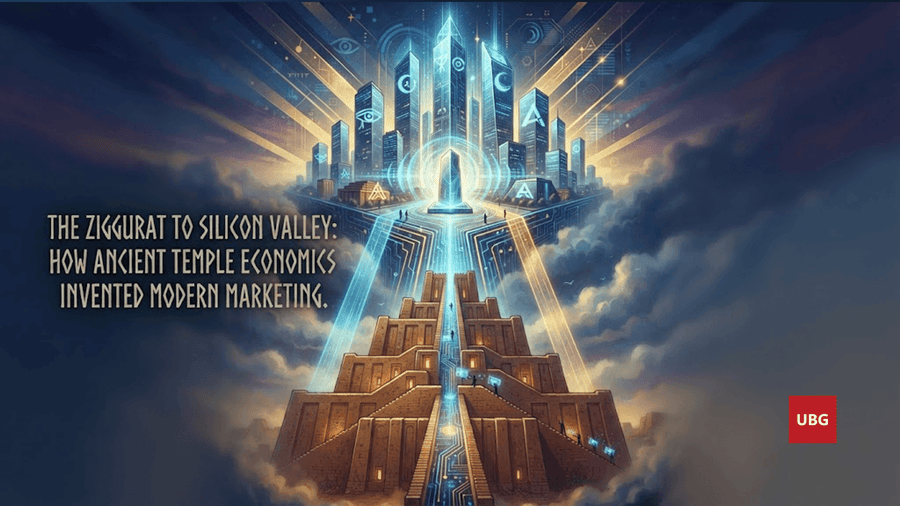
Long before corporate branding existed, the ancient Sumerians and Babylonians engineered the ultimate top-down framework for human compliance and resource management. In cities like Uruk and Babylon, the ziggurat was not just a place of quiet spiritual reflection; it was the central bank, the agricultural hub, the corporate headquarters, and the state propaganda machine rolled into one.
The priests who ran these temple-states did not invent cuneiform writing to record poetry or philosophy. They invented it out of administrative necessity: to track inventory, manage debt, account for grain rations, and run large-scale economic operations.
To keep the system functioning, they deployed a masterclass in narrative control. The core theological premise was simple yet absolute: the land and its resources belonged directly to the gods (such as Marduk or Inanna), and humanity’s sole purpose for existing was to labor and feed them. In exchange, the priesthood offered divine protection, cosmic order, and a sense of meaning. It was the world’s first divine mandate for resource extraction and central planning—proving that theological mythology has always been the most effective tool for managing human behavior.
The Translation: From Pews to Public Relations
When modern public relations and marketing pioneers like Edward Bernays began shaping consumer culture in the 20th century, they didn’t invent new psychological triggers. Sitting at the intersection of mass media and psychoanalysis, they studied how historical institutions successfully compelled millions to alter behavior, suppress doubts, and align their identities with an abstraction.
They took the anatomy of the ancient temple and translated it for the marketplace:
- The Value Proposition: Ancient theology promised salvation from chaos and death; modern commerce promised status, belonging, and self-actualization through consumption.
- The Logo and Symbols: Just as religious icons and sacred geometry instantly communicated tribal affiliation and values, corporate logos became modern tribal markers.
- The Immersive Experience: Temples used incense (olfactory branding), chanting (audio branding), and monumental architecture to overwhelm the senses. Modern flagship stores and experiential retail spaces do the exact same thing.
- Evangelism: The unpaid, zealous brand advocate—whether spreading a religious gospel or camping out overnight for a new smartphone—operates on pure, unadulterated faith.
The Tech Brotherhood and the Return of Soteriology
If the 20th-century consumer era masked its theological roots behind materialism, today’s tech elite have dropped the disguise entirely. Modern tech ideology has revived the original value proposition of ancient theology: salvation and enlightenment.
Strip away the silicon and the term sheets, and the tech narrative mirrors ancient eschatology with high-tech upholstery:
- Original Sin: Instead of moral corruption, our “flaw” is now biological limitation—aging, death, and human cognitive bottlenecks.
- The Apocalypse: Existential risk, climate collapse, and human error are framed with millenarian urgency, demanding absolute faith in the path forward.
- The Savior: Visionary founders and omniscient Artificial General Intelligence act as the high priests and messianic figures meant to lead humanity out of suffering.
- The Rapture: Transhumanism and digital uploading promise a way to leave our “fallen” physical world behind and achieve digital immortality.
The Inescapable Narrative
Humanity keeps trying to engineer the theological impulse out of our operating system, swapping out cathedrals for server farms, gurus for tech founders, and orthodoxy for ideological purity spirals. Yet, whether through ancient Mesopotamian temple economics, historical religious institutions, or modern techno-optimism, the pattern remains identical. We crave a grand narrative, a sense of cosmic order, and a promise that something greater than ourselves will conquer our limitations.
Modern marketing isn’t a new invention of the digital age. It is the oldest human operating system in history, wearing a fresh coat of paint.