The Betrayal of the Logos: Mammon as Modernity
The history of the human spirit is a struggle between two masters. On one side stands the Logos: the principle of objective truth, reason, and divine order. On the other stands Mammon: the spirit of material accumulation, utility, and the modern machine. While the martyrs once carried the torch of the Logos, we now inhabit an era of Mammon’s total triumph, achieved through a sophisticated perversion of history, education, and the human soul.
The Architect of the Vessel
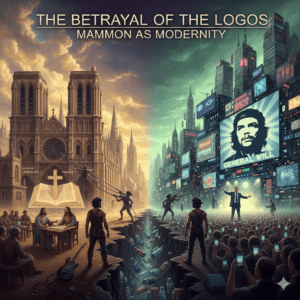
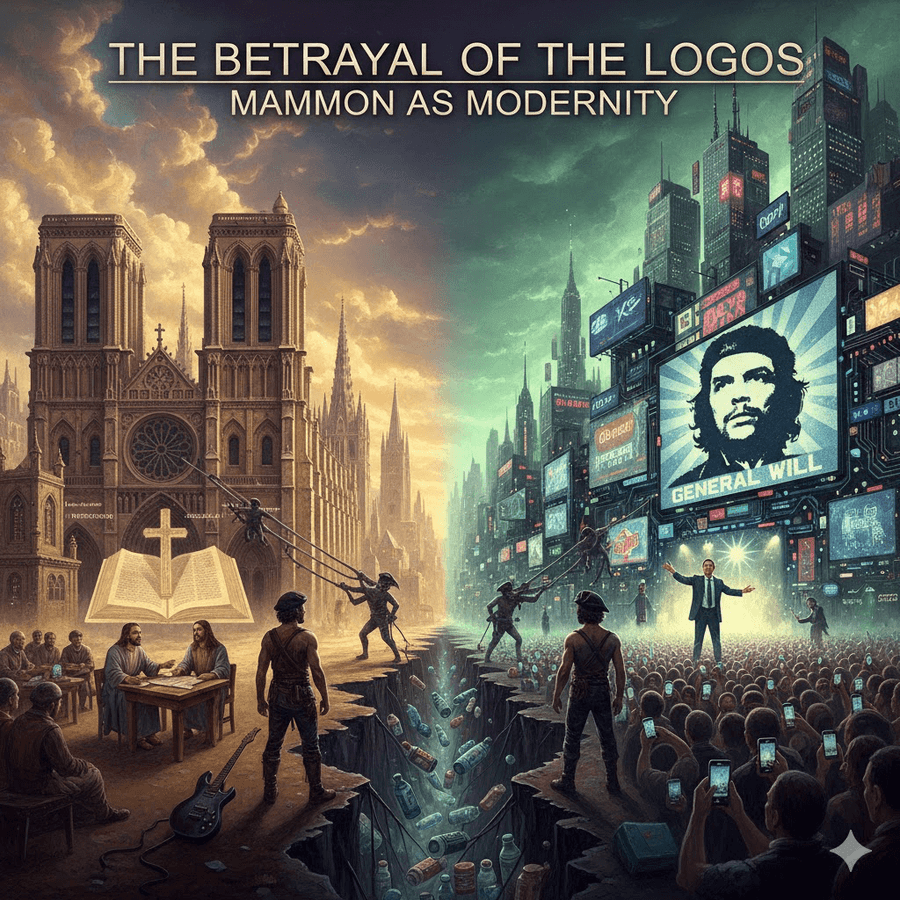
The modern intellectual often treats the University as a secular triumph over the Church, yet the University is a uniquely ecclesiastical creation. The Church was the supreme patron of knowledge and the founder of the world’s most iconic institutions. From the ancient halls of Oxford, Bologna, and Paris to the founding of Harvard and Yale, the Church built sanctuaries for the Logos. These spectacular architectures were “Logos in stone,” designed so that mathematicians and philosophers could serve the Truth without becoming slaves to the marketplace or the whims of a “General Will.”
The Jacobin Henchmen
The descent into modernity began when Rousseau and his Jacobin disciples weaponized the “General Will” to replace the eternal Logos. They claimed to champion “the people,” yet they provided the framework to replace objective Truth with collective impulse. This created the “plausible deniability” that modern intellectuals still use today: they sit in the chairs of learning built by the Church while dismantling the foundations of Truth. They have rebranded the pursuit of God as “ignorance” and the pursuit of gold as “reason.”
The Unpurchasable Line of Succession
Against this betrayal stands a rare line of men who refused to serve two masters. Spartacus fought the physical chains of empire. Jesus challenged the spiritual Mammon of the establishment. Che Guevara, raised in the Catholic settings of the Logos, carried that sacrificial root to his death. Unlike other communist leaders who fought for a terminal power grab, Che walked away from the ministerial palace to die in a muddy trench. At the summit of this lineage stands Socrates, the ultimate form of the Logos, who proved that the Question is more powerful than the state. These figures are linked by a terrifying consistency: they were un-purchasable.
The Great Inversion: From Martyr to Commodity
The triumph of Mammon is most evident in its ability to consume its enemies. We see this in the death of Grunge music, where the raw poetic agony of the 90s was turned into a fashion demographic.The ultimate “blasphemy” occurred when the image of the unpurchasable revolutionary was parodied and morphed into the face of the American political establishment. This mimicry—turning a man who died for his principles into a brand for those who charge six-figure fees for “phoney lectures”—is the final victory of the Machine. It turns the “Narrow Gate” into a VIP entrance. It allows the elite to wear the mask of the rebel while serving the Master of the Market.
The Triumph of the Machine
Modernity is the state of being where the Logos is silenced by the noise of production. We have traded the cathedrals for the marketplace. The “General Will” is now a democratic shield for the worship of Mammon, and the “so-called intellectuals” provide the liturgy for this new religion.To seek the Logos today is to be an exile. It requires a rejection of the Jacobin impulse and a refusal to believe that Truth can be bought or sold. The struggle continues in the quiet, unyielding integrity of those who realize that while Mammon owns the world, the Logos owns the soul.