The Anatomy of Evasion: An Aristotelian Analysis of Strategic Denial
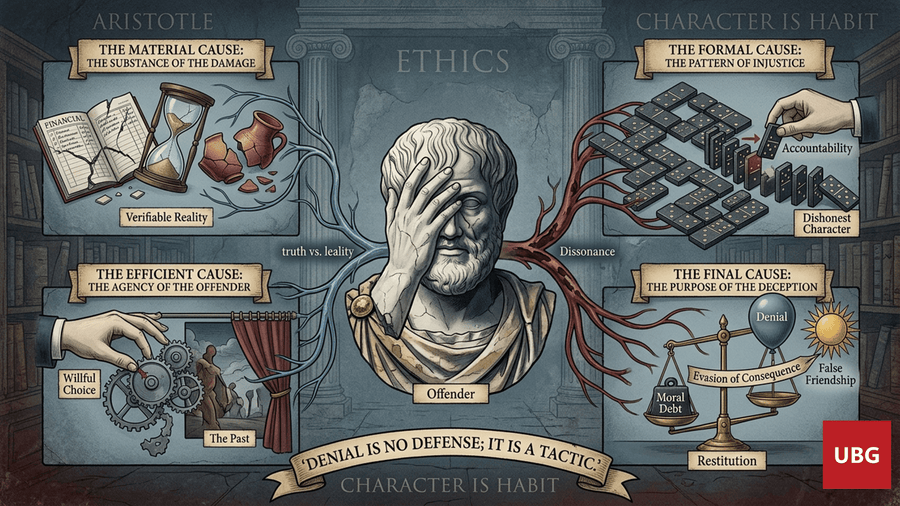
When someone who has caused material damage to our lives later claims they “cannot remember” the offense, or flatly denies it, we are not witnessing a failure of memory. We are witnessing a failure of character. To understand why this behavior is so corrosive to human connection, we can examine it through Aristotle’s Four Causes—the framework he used to explain the “why” and “how” behind any phenomenon.
The Material Cause: The Substance of the Damage
The Material Cause is the “stuff” out of which something is made. In this context, it is the concrete, objective reality of the harm.
Whether it is financial loss, damaged property, or a violation of trust, the material cause is the physical or verifiable reality of what was taken or broken. Because this damage is objective, it exists independently of the offender’s perception. When an offender claims they “don’t remember,” they are attempting to argue that the Material Cause (the harm) never existed. They are trying to turn a tangible fact into a subjective opinion, hoping that if they can dissolve the evidence in your mind, the debt will vanish.
The Formal Cause: The Pattern of Injustice
The Formal Cause is the “shape” or “structure” of the action. The structure of this behavior is injustice masquerading as ignorance.
Aristotle argued that a person’s character is defined by the form of their repeated actions—their habits. When a person denies their own actions, they are establishing a “vicious” form of life. By choosing denial over accountability, the offender patterns themselves into a state of permanent dishonesty. The “form” of this relationship is no longer friendship; it is a hollow structure built on a foundation of lies, rendering the relationship fundamentally malformed.
The Efficient Cause: The Agency of the Offender
The Efficient Cause is the primary agent or force that brings something about. In this case, the efficient cause is the willful choice of the offender.
They are not “forgetting” because of cognitive decline; they are choosing to “forget” as a deliberate act of self-protection. This is a tactical maneuver designed to alleviate their own discomfort, preserve their reputation, and exert power over the victim. They are the active agents of their own revisionist history. The “forgetting” is not an accident of the mind—it is a weapon of the will.
The Final Cause: The Purpose of the Deception
The Final Cause is the “end goal” or the telos of an action. Why are they doing this? The telos here is the evasion of moral debt.
By denying the past, the offender seeks to bypass the “pain” of accountability—the necessity of restitution, apology, or change. They want the social benefit of being seen as a “good person” and the utility of your friendship without the cost of admitting their past wrongs. However, because they have failed to achieve the true telos of human interaction—which, according to Aristotle, is virtuous friendship based on truth—their attempt at reconciliation is inherently doomed.
Conclusion: The Truth Remains
Aristotle reminds us that “the truth is the same for all.” A person who refuses to acknowledge the damage they have caused is someone who has rejected the shared reality necessary for human community.
When you refuse to forgive someone who has not repented, you are not being vengeful; you are being philosophically accurate. You are refusing to validate a “final cause” (the evasion of debt) that is fundamentally unjust. In the Aristotelian sense, by holding the line on your own reality, you are maintaining the integrity of your own character—something that no amount of the other person’s denial can ever truly break.