The Architecture of the “Fourth Pillar”: How the Press Sustains the Shadow State
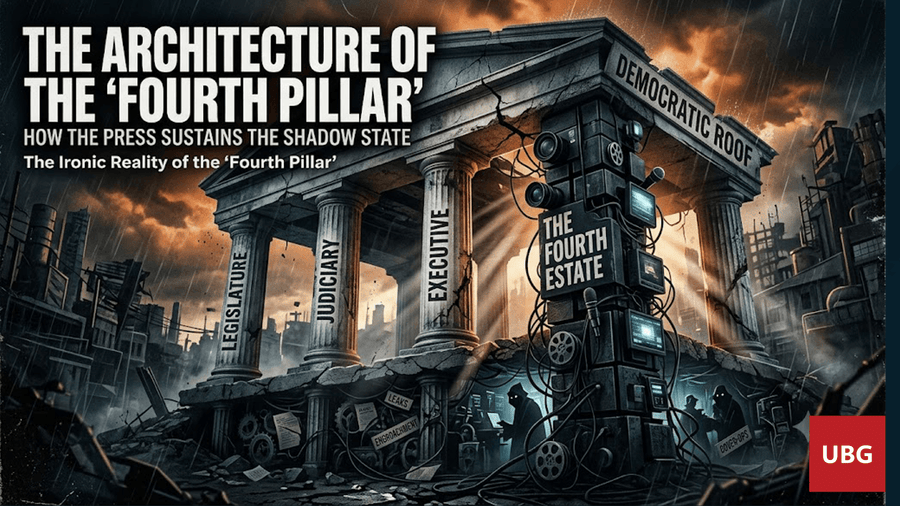
The democratic ideal positions the press as the Fourth Estate—an independent watchdog designed to hold the executive, legislative, and judicial branches accountable. In a healthy society, this pillar stands apart from the architecture of power, keeping the structure honest. However, within a compromised political ecosystem, this relationship undergoes a dark inversion. Instead of auditing the state, the media becomes integrated into it, transforming from a critic of systemic corruption into its primary load-bearing pillar.
From Watchdog to Mouthpiece
The structural utility of the media in a shadow-state ecosystem relies on a fundamental paradox: the public must believe the press is free for its propaganda to be effective. When a mainstream news outlet validates a staged police “encounter” or reproduces a manufactured security threat, it performs a function that the state cannot achieve on its own. It converts raw, extrajudicial violence into societal consensus. By laundering state-sponsored narratives through the language of objective journalism, the media grants immediate legitimacy to actions that would otherwise provoke outrage or legal scrutiny.
The Anatomy of Complicity: Ignorance vs. Intent
The journalists who champion the myth of the Fourth Pillar while actively propping up a corrupt house generally fall into two distinct camps: the systemically naive and the consciously embedded.
For the majority of ground-level reporters, compliance is driven by institutional design rather than malice. Trapped in a fast-paced cycle of access journalism, these professionals rely entirely on official sources—such as police briefings and intelligence leaks—to secure headlines. They operate under the illusion of objectivity, mistaking the stenography of power for the reporting of truth. They wear the badge of the Fourth Estate proudly, entirely blind to how their professional routines are weaponized to cover the tracks of the underworld and the security apparatus.
Conversely, at the apex of the media hierarchy sits a layer of conscious collaborators. For senior editors, executives, and media moguls, the invocation of democratic ideals is a calculated strategy of gaslighting. These actors maintain direct lines of communication with political fixers and intelligence handlers, deliberately spiking investigative pieces into financial fraud or land disputes to protect mutual interests. For this group, the “Fourth Pillar” is not a mission, but a shield—a prestigious corporate brand used to mask their role as the public relations wing of a shadow government.
Perverting the Democratic Architecture
Ultimately, the perversion of the media’s role paralyzes the remaining branches of government. By creating a continuous smokescreen of manufactured crises and selective reporting, the press insulates the judiciary and the legislature from pressure to enact internal reform. Rather than exposing the financial ledgers or bribery networks that bind the formal state to the underworld, the media directs the public’s attention away from the source of the rot. The tragic irony of the modern Fourth Estate is that the system no longer requires every journalist to be corrupt; it merely requires them to be compliant, ensuring that the roof of the corrupt house remains securely held in place.