The Tragedy of Sadhu Bhasa: How the Westphalian Model Strangled Bengali’s Advanced Civilizational Language Engine
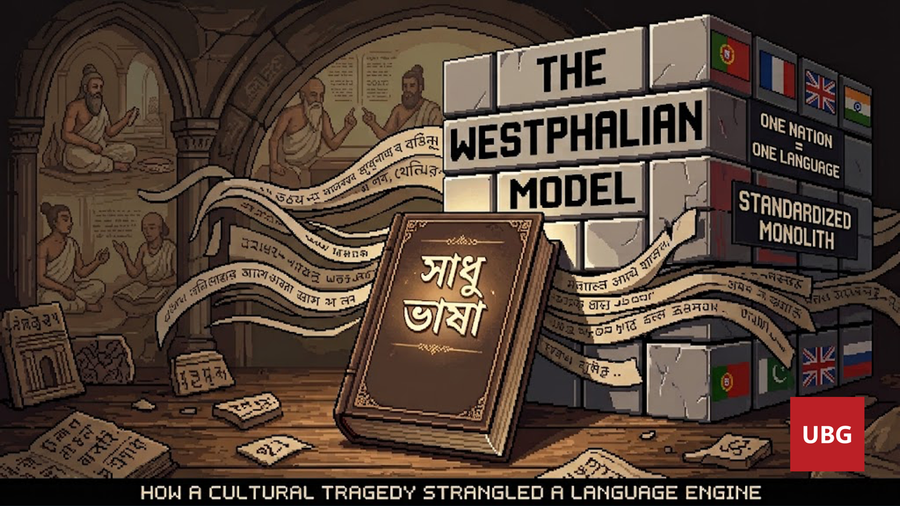
The Genius of the Ancient Dual Engine
Long before European expansion flattened global linguistic landscapes, advanced civilizations understood a fundamental truth about communication: a single, one-size-fits-all language register is a structural bottleneck. From the Mediterranean to South Asia, thriving cultures operated under a sophisticated system known as diglossia. They maintained two distinct tiers of language: a fluid, hyper-adaptive vernacular for daily trade and street life, and a stable, high-precision classical register for philosophy, statecraft, and deep science. For centuries, the Bengali language operated on this exact blueprint through the harmonious coexistence of Chalti Bhasa (the dynamic spoken vernacular) and Sadhu Bhasa (the highly structured, root-based literary anchor). This was not a primitive state of confusion, but a highly evolved civilizational strategy designed to balance rapid daily change with timeless intellectual precision.
The Importation of the European Tribal Blueprint
The disruption of this elegant linguistic ecosystem began with British colonial engineering. European powers, emerging from a history of tribal feudalism and frantic nation-building, brought with them a rigid mental model: Standard Language Ideology. Their formula was simple and blunt: One Nation = One People = One Standardized Language. Europe had discarded its own civilizational luxury—the use of a stable classical anchor like Latin for high thought—and forced localized street vernaculars to violently absorb all functions of society. When British Orientalists established Fort William College in 1800, they viewed Bengali’s natural internal diversity as a defect to be corrected. To make the language legible to a colonial bureaucracy, they artificially hyper-Sanskritized a formal prose standard, separating it from the organic soil of the spoken dialects, while introducing the Western myth that a “civilized” society must speak and write in a singular, homogenized monolith.
Weaponizing Nationalism to Flatten the Architecture
This imported European framework was successfully injected into the native consciousness through the rise of modern nationalism. To compete with the West and assert their own modernity, 19th-century post-colonial and nationalist intellectuals internalized the British critique. They began to view regional dialects and the natural, fluid borrowing of the vernacular as markers of backwardness. Nationalism demands a singular, sacred monolith to rally around, and in the rush to institutionalize a uniform national identity, the complex, multi-tiered architecture of Bengali was systematically flattened. The natural division of labor between the two registers was broken. Instead of celebrating a dual-engine system that kept the language both culturally anchored and wildly adaptive, modern institutions began to police Bengali to fit the Western mold of a uniform national tongue.
The Slow Strangulation of Sadhu Bhasa
The ultimate tragedy of this transformation was the slow, deliberate strangulation of Sadhu Bhasa throughout the 20th century. Dismissed by modernizers as “stiff,” “anachronistic,” and “elitist,” this high-precision register was progressively phased out of textbooks, media, and academic discourse. What these reformers failed to realize was that Sadhu Bhasa possessed an algorithmic, root-morphology derived from Sanskrit that operated less like casual speech and more like a mathematical programming language. Through its system of prefixes and suffixes, it had the innate capacity to generate highly specific, unambiguous terms for abstract concepts on demand. When European scientists needed to articulate quantum mechanics or calculus, they didn’t use the street slang of London; they reached back to the stable classical pools of Latin and Greek. By discarding Sadhu Bhasa, Bengali institutions threw away their own built-in classical engine.
The Modern Panic: Reinventing the Wheel
Today, contemporary Bengali academia finds itself trapped in a self-inflicted crisis, panicking over the language’s supposed inability to express modern technical, scientific, and philosophical ideas. This is a profound historical misunderstanding. Bengali does not require radical linguistic “reforms” to teach physics, mathematics, or Western philosophy; it already possessed the perfect tool. Having strangled the engine designed for high-level abstraction, modern committees are now trying to “reinvent the wheel” by forcing Chalti Bhasa—a register structurally designed for fluid, conversational emotion—to perform the work of a precision laser. When everyday Bengali predictably feels awkward explaining advanced thermodynamics, institutions blame the language itself and default entirely to English. The ongoing struggle to articulate complex modern ideas is not an organic failure of the Bengali language, but the lingering aftermath of a colonial hangover that traded an advanced civilizational tool for a basic, Western framework.