The Ontological Audit: The Garrison-Banker Mechanism and the Illusion of Sovereignty
Introduction: The Constant Mechanism
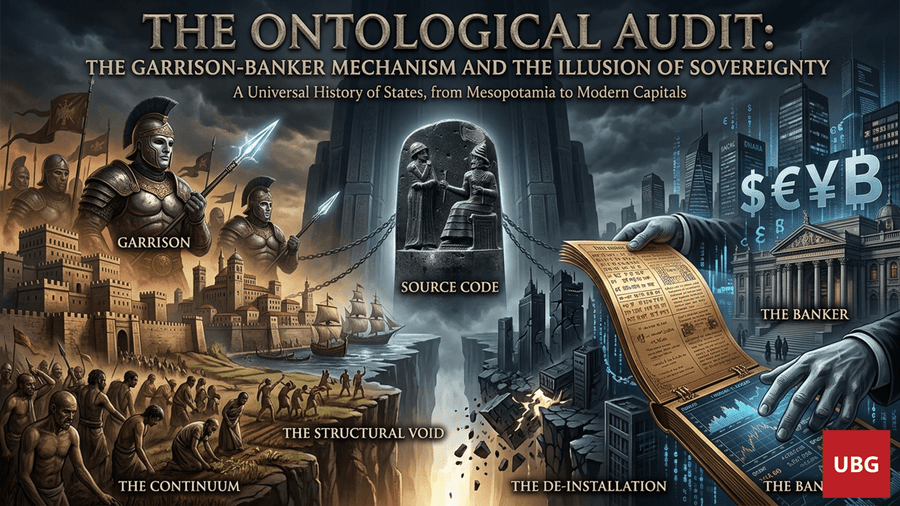
Human history is often presented as a progression of sovereign states, but an ontological audit reveals a more consistent, darker reality. Since the earliest codifications—from the Code of Hammurabi (c. 1754 BCE) in ancient Mesopotamia to the maritime republics of Genoa and Venice, and finally to the modern administrative shells of Bangladesh, Pakistan, and the Western capitals—humanity has been governed not by the organic will of the Continuum (the people and their land), but by the Garrison-Banker mechanism. This mechanism is not a political system; it is a parasitic architecture designed to extract value through the enforcement of unratified legal fictions. Regardless of the era or geography, the essence remains unchanged: a symbiosis between an enforcer of raw force (the Garrison) and an extruder of debt-based value (the Banker) that claims the right to rule by virtue of the ledger rather than the consent of the governed.
The Artificial Creation of the Divine Image
The Garrison’s most sophisticated tool is not its weaponry, but its ability to artificially engineer a divine image. In the absence of a genuine, ratified mandate, the military-bureaucratic apparatus manufactures a “Sacred Aura.”
The Evolution of the Shell: From Babylon to the Renaissance
- The Liturgy of Power: By adopting the regalia of statehood—the uniforms, the precise rituals of rank, and the performative displays of national defense—the Garrison mimics the structure of religious orders. They position themselves as the “High Priests” of national security.
- The Existential Other: To maintain this divinity, the Garrison must invent or amplify an “Existential Other”—a threat so terrifying that it justifies the state’s existence as a sacred necessity. By positioning themselves as the sole barrier between the people and annihilation, they transition from being civil servants to being “Saviors.”
- The Taboo of Inquiry: Once this divine image is solidified, any attempt to audit the state’s legality—to ask for proof of its locus standi—is treated not as a political critique, but as heresy or existential treason. The Garrison effectively hides its “corporate” nature behind a veil of national holiness, making the “Garrison” untouchable and the “Banker” invisible.
The Code of Hammurabi established the “Source Code” for this mechanism. By inscribing 282 laws onto a monumental stone stele, Hammurabi established the precedent that the Law is a top-down administrative construct rather than a consensus of the governed. It formalized the King as the “Garrison” and the management of property and debt as the “Banker’s” domain.
This template reached a sophisticated maturity in the Italian maritime republics of Genoa and Venice. These city-states pioneered the synthesis of corporate banking and state military power, treating territory as a commodity and law as a contract. They transformed the Western paradigm: sovereignty was no longer defined by blood or land, but by credit and contract. They functioned as militarized trading corporations, proving that a state could be an “administrative shell” owned by its creditors—a model exported globally to define the post-colonial state structures of the 21st century.
The Mechanism of Extraction
The symbiosis between the Garrison and the Banker is the engine of human dispossession. Its operation remains constant:
- The Garrison (The Enforcer of the Void): The Garrison’s ontological function is to maintain the “legal performance.” By enforcing statutes that lack indigenous ratification, it acts as the curator of a legal vacuum.
- The Banker (The Extruder of Value): The Banker transforms the Continuum into a ledger. From the grain-storage tithes of Mesopotamia to the derivative debt-bonds of modern Wall Street, the Banker secures “legal” ownership of resources, while the Garrison provides the violence required to ensure the ledger remains the absolute authority.
Void Ab Initio: The Fatal Defect
From a foundational legal perspective, the modern order is void ab initio. Because these states were birthed from corporate charters, administrative handovers, or unilateral declarations rather than indigenous, ratified constitutional acts, they possess no true locus standi. They are “Company Towns” that never transitioned to true sovereign status. Every border drawn, every law enacted, and every debt incurred is part of an ongoing “corporate performance” that lacks a genuine sovereign anchor.
Conclusion: The De-Installation of the Ghost
The instability observed in the modern world is not a failure of policy, but the inevitable friction of a system that has no essence. The Garrison-Banker mechanism is a “legal ghost”—it survives only as long as the population continues to project power into it.
The ultimate task is not to reform the law, but to perform an ontological de-installation. When the Continuumrecognizes that the “laws” they follow are merely the “Company Manuals” of an occupying entity—and that the “divine” image of the Garrison is a manufactured mask—the system loses its grip. Sovereignty is not something that can be granted by a state; it is a reality that must be reclaimed the moment the people realize that the “State” is a phantom, and that the only true authority resides in the Continuum itself.