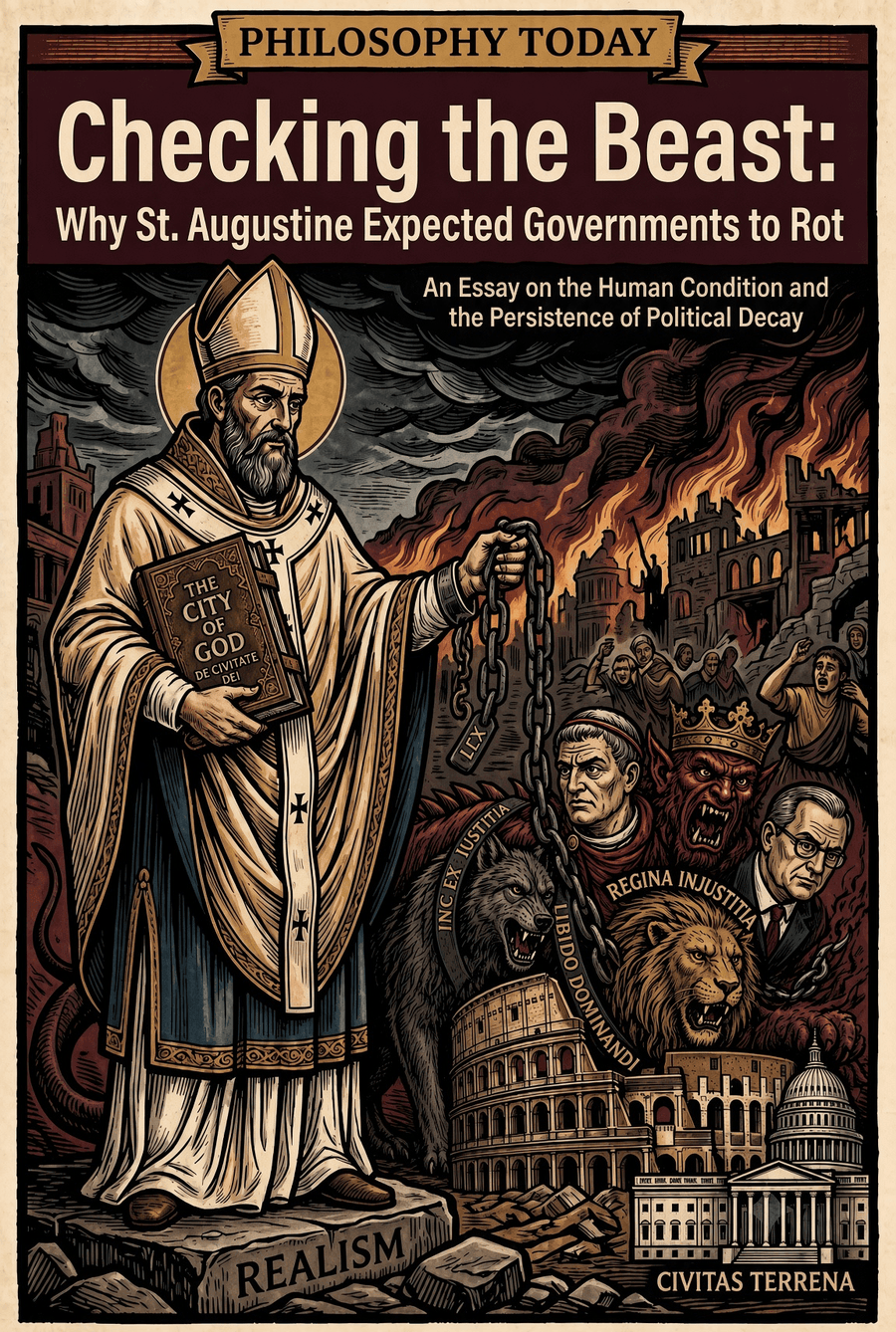
Checking the Beast: Why St. Augustine Expected Governments to Rot
The Flattering Delusion of Modern Reform
The modern war on corruption is built on a flattering delusion: the belief that if we only construct the right institutions, code the right algorithms, and enforce the right transparency protocols, we can finally engineer an incorruptible government. We treat corruption as a temporary design bug, a technical glitch to be patched by technocrats and policy paperbacks. Yet, across every century and every continent, the same rot inevitably returns, devouring anti-corruption bureaus, subverting democratic checks, and bending legal frameworks to serve private gain. To understand why our modern remedies continuously fail, we must abandon our secular utopianism and return to the sobering realism of a fifth century North African bishop: St. Augustine of Hippo.
The Anatomy of Disordered Loves
For Augustine, political corruption was neither an administrative oversight nor a malfunction of the state; it was the inevitable expression of the human condition. In his masterpiece The City of God, written as the Roman Empire crumbled around him, Augustine dismantled the illusion that human politics could ever achieve moral perfection. He located the root of political decay not in flawed laws, but in what he termed the libido dominandi, the unrestrained, fallen human lust for power and domination. Every human institution is designed and operated by creatures governed by disordered loves, individuals who naturally prioritize self-preservation, status, and wealth over abstract notions of justice. When modern reformers express shock that politicians enrich themselves or that institutions protect their own power, Augustine would view their outrage as naive. A state composed of fallen human wills cannot magically transcend the moral nature of the people who run it.
Kingdoms as Syndicate Robberies
This fundamental diagnosis leads to Augustine’s most blistering critique of state authority: without genuine, transcendent justice, political power is simply criminal enterprise with a flag. “Justice being taken away, then, what are kingdoms but great robberies?” he famously asked. In the Augustinian view, the “City of Man”, the realm of earthly politics, is inherently unstable because it is fueled by amor sui, the love of self to the contempt of God and neighbor. Checks and balances, regulatory boards, and legal codes are not guarantees of virtue; they are merely ropes tied around a wild animal. They can delay the beast’s rampage, but they can never change its nature. When a society loses its moral foundation, its leaders will eventually learn to subvert the very laws meant to constrain them, turning the tools of anti-corruption into instruments for consolidating wealth and crushing rivals.
Pragmatic Containment in the City of Man
Yet, Augustinian realism is not a call to fatalism or political withdrawal. Augustine did not advise citizens to abandon public life, nor did he dismiss the necessity of human law. Instead, he offered a philosophy of pragmatic containment: the purpose of the state is not to establish a heaven on earth, but to restrain the worst impulses of a fallen world. Government exists to secure an imperfect, temporary “earthly peace” (pax terrena), a baseline of order that prevents society from descending into total anarchy. The ethical citizen’s duty is to serve honorably, enforce laws strictly, and mitigate harm, all while harboring no illusions that political victories will ever permanently purge human rot. We must check the beast precisely because we know it cannot be domesticated.
The Technocratic Illusion
The tragedy of the modern age is that we have inherited all of Augustine’s political machinery, the police powers, the courts, the administrative bureaucracy, while discarding his diagnosis of human nature. We continue to promise utopian cleanups while ignoring the internal condition of the human heart. Until we trade our technocratic arrogance for Augustinian humility, our political cycles will remain locked in the same predictable tragedy: building grand new institutions to slay the monster of corruption, only to watch those institutions become the monster’s new home.