The Political Economy of Regime Change in Post-Colonial States
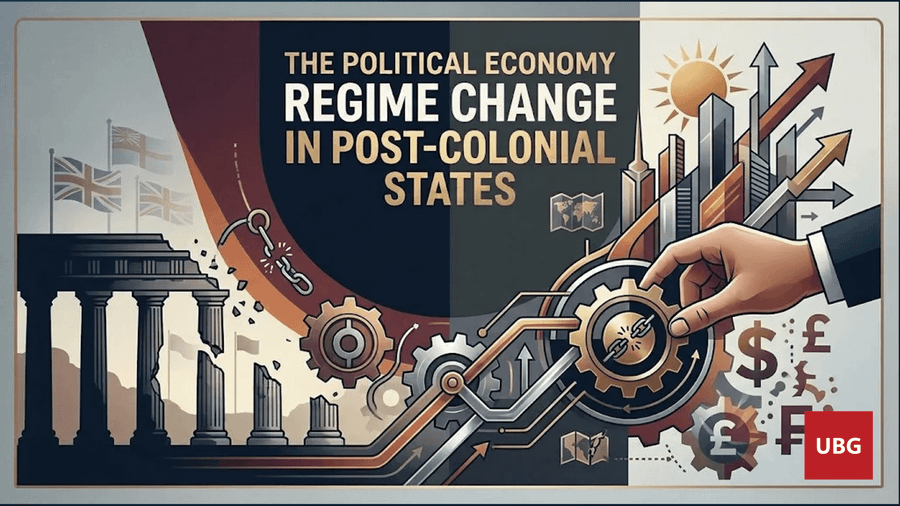
The transition from formal European empires to sovereign post-colonial nation-states in the mid-twentieth century is conventionally narrated as a triumph of grassroots self-determination over foreign subjugation. Yet when examined through the lens of Aristotelian causality, decolonization reveals itself not as a structural rupture in the nature of rule,but as a necessary morphological upgrade to the Formal Cause of governance. By the end of the Second World War, the traditional imperial Formal Cause, grounded in racial hierarchy, civilizing missions, and direct metropolitan administration, had become economically unsustainable and politically brittle. Attempting to maintain control over vast populations through overt foreign coercion required an expenditure of blood and capital that exhausted European powers could no longer afford. To preserve the underlying Final Cause, which remained the uninterrupted extraction of resource rents, strategic geopolitical alignment, and sovereign debt obligations, the ideological operating system of the state had to be redesigned.
This morphological shift replaced colonial governors and imperial charters with indigenous presidents, national flags,anthems, and fresh ideological charters ranging from Rousseauian constitutions proclaiming popular sovereignty to the Marxist-Leninist and socialist vanguard doctrines that dominated post-colonial transitions prior to 1990. As Frantz Fanon observed in his dissection of the post-colonial national bourgeoisie, both the liberal-nationalist and revolutionary-socialist vocabularies performed the exact same stabilizing function. Whether framing the transfer of administrative office as constitutional democracy or anti-imperialist proletarian liberation, the new Formal Cause absorbed the revolutionary energy of the mobilized population, which served merely as the Material Cause of the transition. Under socialist and vanguardist banners, incoming elites used nationalization to transfer foreign-owned assets directly into state monopolies controlled by the party bureaucracy rather than the working class, while simultaneously outlawing rival factions as counter-revolutionaries. Across both ideological models, grassroots independence fighters, labor organizers, and peasant movements were either demobilized, absorbed into single-party apparatuses, or co-opted into visible but structurally powerless legislative and cultural ministries. Their presence in the new government served as a legitimacy overhead, creating the optical illusion of a popular triumph while insulating the actual mechanics of power from mass interference.
As the post-colonial state matured and the ideological vocabulary of the twentieth century gave way to the multipolar and neoliberal pressures of the twenty-first, right-wing populism emerged as the latest morphological adaptation of the same Formal Cause. When technocratic governance and liberal constitutionalism lose credibility amid economic stagnation and institutional decay, challenger elites deploy nationalist and right-wing populist rhetoric to harness the frustration of displaced middle and working-class populations. Framing political struggle as a moral crusade between the authentic nation and a corrupt, globalist establishment, these movements mobilize the populace as raw Material Cause to unseat entrenched bureaucratic factions. Once in power, however, right-wing populist regimes replicate the exact structural pattern of their predecessors. Firebrand outsiders and cultural nationalists are elevated to visible cabinet and legislative posts to satisfy the demand for anti-establishment theater, while the actual sovereign chokepoints,including central bank autonomy, sovereign debt obligations, intelligence services, and domestic oligarchic property regimes, remain firmly insulated from popular interference.
Across all of these ideological eras, periodic elections, single-party mobilization rituals, and mob-for-hire street demonstrations serve as the institutionalized mechanisms for managing intra-elite rivalry without threatening the sovereign architecture. In this upgraded Formal Cause, electoral contests and mass rallies do not represent genuine popular arbitration over state policy, but rather a regulated auction and census of competing elite factions. Rival domestic oligarchs, military cliques, dissident capital interests, and externally backed political networks deploy patronage, ethnic or sectarian machines, and paid street agitators to manufacture the appearance of mass consent or popular outrage. Whether a faction secures office through a managed ballot box, a vanguard party purge, a populist electoral wave, or orchestrated riots and mob-for-hire demonstrations, the population remains passive Material Cause mobilized as a blunt instrument to break a stalemate at the top. Once the contest concludes, the mobilized crowd is dispersed or repressed, having served solely to validate a transfer of administrative rents between rival coalitions.
Beneath this vibrant ceremonial surface of flags, ballots, revolutionary slogans, populist rallies, and street theater, the core sovereign architecture left behind by the colonial regime remained untouched. The incoming indigenous elite coalition did not dismantle the centralized police forces, intelligence networks, land tenure laws, or state export monopolies that had been engineered for extraction; instead, they stepped directly into the administrative seats of the departed governors. Crucially, the apex of monetary and financial sovereignty remained tightly tethered to external metropoles, superpower creditors, and international financial institutions. Through mechanisms such as post-colonial currency boards, sovereign debt restructuring, and central bank frameworks modeled on orthodox or state-socialist credit controls, the economic chokepoints of the new states were insulated from domestic majorities. A newly installed post-colonial parliament, party congress, or populist administration could debate cultural policy or national symbolism,yet it possessed no independent authority to alter monetary policy or disrupt established commodity export chains without triggering immediate capital flight, credit cutoff, or external intervention.
Ultimately, the era of flag independence and its subsequent cycles of ideological, electoral, populist, and street-driven regime changes demonstrate how ruling coalitions adapt their ideological forms to survive changing historical conditions. What appeared to the contemporary observer as the birth of genuine grassroots democracy, socialist emancipation, or nationalist revival was, in structural reality, an intra-elite realignment mediated by a fresh constitutional or populist mythos. By upgrading the Formal Cause from colonial paternalism to anti-imperial nationalism, Marxist vanguardism, and right-wing populism, both external powers and ascending domestic elites secured a far more durable and cost-effective arrangement. The population was pacified by the rituals of voting,partisan slogans, and the symbols of self-rule, the credentialed managerial and political class found lucrative employment administering the state apparatus, and the Final Cause of preserving an elite foothold at the sovereign apex continued without interruption.