The Bond Villain Trap: Despots Die for Applause; Empires Play the Long Game
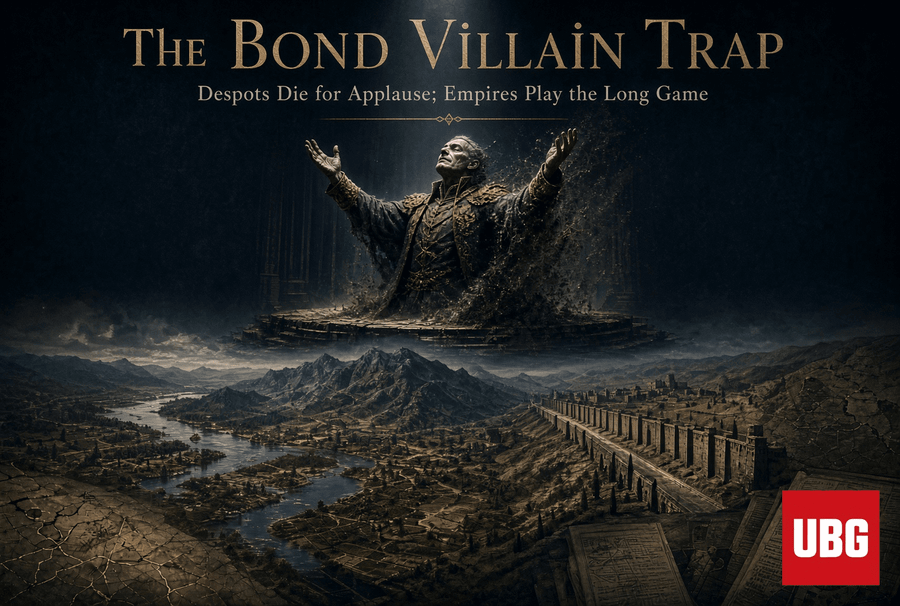
History belongs to silent structures, including Pharaonic river basins, Roman frontiers, the Anglosphere mosaic, and deep-time mountain networks, that outlast court scribes and academic apologists. Mainstream historical scholarship inherits the DNA of medieval court scribes, converting messy administrative realignments and imperial exhaustion into sudden, divine epics of miraculous conquest. Court chroniclers manufactured origin myths to justify sovereign rule,erasing ecological exhaustion, tax realities, and structural decay from the ledger. Modern ivory-tower historians cling to clean, linear narratives because institutional funding and tenure demand dramatic personalities rather than cold logistical audits. Superpowers and empires do not fall to sudden divine lightning; imperial cores overextend beyond ecological and administrative limits, leaving vacant margins to quietly absorb the shift.
This theatrical vanity reaches its psychological zenith in the post-colonial supervillain blueprint. Before any execution can take place, James Bond must be given a pristine tuxedo, seated at a mahogany dining table, and served a vintage 1961 Dom Pérignon. The villain cannot pull the trigger until explaining the precise mathematical elegance of an orbital laser or economic collapse plan. Dismissing this routine as campy cinematic convention misses the core psychological engine of the franchise. The supervillain does not just want world domination; they want a peer review. In their mind,James Bond, the quintessential representative of the British imperial establishment, is the only person in the room with a high enough security clearance and refined enough taste to truly appreciate their brilliance.
When Ian Fleming wrote Casino Royale at his Goldeneye estate in Jamaica in 1952, he sat at the literal epicenter of the British Empire’s dissolution. Across the Americas, Asia, and Africa, former colonies declared independence,established sovereign borders, and built rapid industrial infrastructure. For the British upper-class establishment, this post-imperial shift bred deep cultural anxiety, which Fleming channeled directly into his villains. Whether Dr. No on his private Jamaican island, Scaramanga in his South China Sea retreat, or Blofeld inside a volcanic fortress, the villain constructs an autonomous territory. They design custom uniforms for their staff, establish private internal armies, and build high-speed industrial facilities around strategic commodities. Prior to Bond’s arrival, the villain’s lair represents the ultimate post-colonial ambition made manifest: total self-reliance, massive technological infrastructure, and complete freedom from Western control.
This subtext peaked in Octopussy, where the post-colonial terrain of India became the backdrop for a secret alliance between an exiled prince and the Soviet military machine. General Orlov and Kamal Khan embodied the exact geopolitical pivot that haunted Western intelligence throughout the Cold War, as newly independent non-aligned states turned away from former colonial masters. Kamal Khan operated out of an opulent Monsoon Palace in Udaipur,surrounding himself with traditional signs of royal status while secretly smuggling stolen Soviet treasures to fund a rogue nuclear strike against NATO. Yet, he still insisted on hosting Bond at his high-stakes backgammon table and serving him a formal dinner. Even when aligning with the Eastern Bloc, the post-colonial aristocrat could not resist showing off his Western sophistication to the British operative.
The structural flaw of both Fleming’s villains and their real-world historical mirrors, such as Muammar Gaddafi,Saddam Hussein, or Idi Amin, is that domestic control is profoundly unfulfilling. When a ruler possesses absolute power over their own territory, domestic praise becomes completely worthless because henchmen threatened with a shark tank offer zero genuine critique. The villain sits in a fortress of absolute authority, suffocating in existential boredom and legitimacy anxiety. To cure this numbness, the mastermind requires a true peer: someone who cannot be bought, coerced, or easily awed. James Bond steps directly into that void, forcing the mastermind into a tragic, self-sabotaging trap. They build a doomsday device to break free from Western dominance, yet they frame their achievement entirely around the West’s attention. It is the cinematic equivalent of Gaddafi pitching an air-conditioned Bedouin tent in New York to deliver a ninety-six-minute UN monologue, or Saddam Hussein stamping his own name onto the ancient bricks of Babylon alongside Nebuchadnezzar. They do not want to quietly succeed; they want to stage a theatrical performance where the British agent is a mandatory captive audience.
Enduring power operates on structural permanence rather than public relations. Sustainable states know their exact logistical limits, refusing the vanity of endless foreign crusades, just as Pharaonic Egypt stayed anchored to the Nile and Rome stopped safely at the Euphrates. Regional actors absorb operational friction, weaponize time, and let impatient industrial empires exhaust their political capital. Real power runs on unwritten custom, precedent, and deep-time continuity, requiring no custom uniform, press conference, or court scribe. By forcing the villain to crave Bond’s approval, Fleming gave post-war Britain its ultimate literary revenge fantasy. Britain may have lost its economic empire and naval fleets, but in the world of James Bond, the world still turned on British taste. The villain could acquire nuclear warheads, sub-orbital lasers, and billions in raw capital, but mentally, they remained trapped in the former master’s house, wearing the tuxedo, pouring the Dom Pérignon, and begging the man from London to acknowledge that the logistics of their global conquest were truly immaculate.
The Bond villain dies in a subterranean lair because the villain believes power is loud. Real power sits quietly in the dark, keeping borders secure, and waiting for the noisy upstart to trip over an overextended cape. The ink of the court scribe fades, the theatrical despot falls, but the silent, structural machinery of ancient statecraft remains.