The Magadhan Root of Bengal’s Spirit
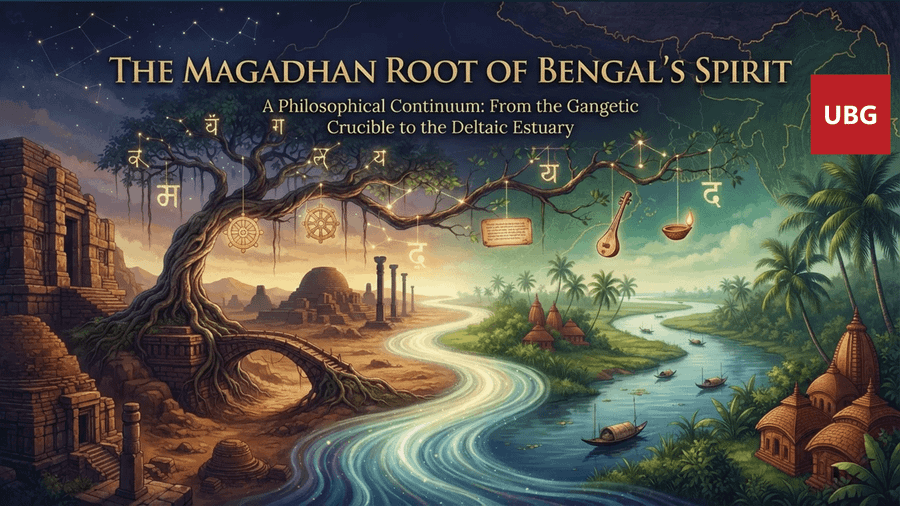
Understanding the soul of Bengal, one must look upstream, both geographically along the Ganga and temporally into the philosophical crucible of ancient Magadha. In the Indian civilizational imagination, geography is rarely a mere boundary; it is a vessel of consciousness. Magadha, the rugged heartland of southern Bihar, was the great furnace where heterodox thought challenged rigid orthodoxy, giving birth to Buddhism, Jainism, and the Ajivika tradition. Bengal, situated where the mighty rivers widen into a lush, shifting delta before meeting the sea, became the fertile estuary where those radical ideas softened, deepened, and flowered into lived poetry. Rather than two isolated regions separated by modern cartography, Magadha and Bengal represent two phases of a single philosophical breath: the austerity of the inquiry and the lyricism of its realization.
At the core of this continuum lies a shared rebellion against spiritual determinism. Ancient Magadha was the epicenter of the Shramana movement, a philosophical awakening that asserted human agency, ethical responsibility, and inner awakening over ritualistic birthright. When this current flowed eastward into the ancient janapadas of Vanga, Pundra, and Rarh, it encountered a landscape defined by fluidity, monsoons, and constant renewal. In Bengal, the sharp, analytical edge of Magadhan renunciation met the warmth of agrarian mysticism. Over centuries, the austere monasticism of Nalanda and Rajgir merged with the esoteric traditions of eastern India, giving rise to Vajrayana Buddhism and the Charyapada. These mystical verses, composed in the twilight language of Magadhi Apabhramsha, envisioned the human body itself as a sacred universe, where liberation was sought not by fleeing the world but by seeing through its illusions.
Language itself stands as the most enduring monument to this philosophical kinship. Every time a Bengali speaker forms a sentence, they are breathing life into the linguistic descendants of Magadhi Prakrit, the very tongue in which the Buddha and Mahavira once spoke to ordinary people to dismantle the monopoly of elite Sanskrit. This was never merely a phonetic evolution; it was an epistemological shift. By insisting that profound truth belonged in the vernacular of the potter, the boatman, and the weaver, Magadha bequeathed to Bengal a democratic ethos of thought. That legacy echoed centuries later in the songs of the Bauls, the egalitarian fervor of Chaitanya Mahaprabhu’s Bhakti movement, and the humanist renaissance of nineteenth-century Kolkata, all of which retained the ancient Magadhan instinct to question dogma and place human experience at the center of the sacred.
Ultimately, the relationship between Magadha and Bengal invites us to rethink how civilizations endure. Empires built from Pataliputra rose and crumbled into dust, their stone pillars weathered by time, yet the subtle architecture of thought they carried eastward proved indestructible. Magadha supplied the bedrock of introspection, rational skepticism, and compassion; Bengal gave it rhythm, devotion, and an artistic sensibility that turned philosophy into song. Like the river that binds their soil, the dialogue between the two lands reminds us that ideas are never static. They travel, adapt to new landscapes, and find their fullest expression when rigor meets grace.