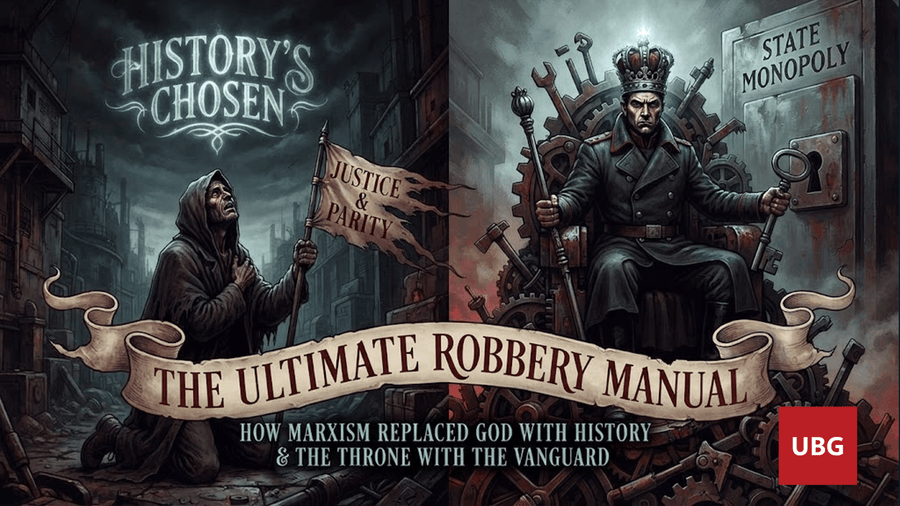
The Ultimate Robbery Manual: How Marxism Replaced God with History and the Throne with the Vanguard
For over a century, Marxism has been debated as an economic science, a philosophy of history, and a grand blueprint for human liberation. Yet, when you strip away the dense jargon of Das Kapital and the revolutionary fervor of The Communist Manifesto, a far more unsettling reality emerges.
Marxism was never a practical architectural plan for a functional, egalitarian society. It was a brilliant, secularized theological heist, and the ultimate, macro-scale robbery manual.
The Secularized Heist: Trading God for History
Marx famously claimed his theory was a cold, hard science of material production, entirely divorced from morality and religion. Yet, the deep structural engine of Marxism is entirely theological.
In the biblical tradition, God is the God of history. He acts through empires, exiles, and wars, and famously chooses the Israelites not because of their moral purity, virtue, or righteousness, but according to His historical covenant and plan. In Deuteronomy, Moses even warns the people that they are stiff-necked and unmeritorious.
Marx performed a masterstroke of secular plagiarism: he kept the narrative engine of the Bible, but edited out the divine author.
The New Deity: History.
The Chosen People: The proletariat. Just like biblical Israel, the working class is not chosen because they are saintly, enlightened, or morally pure. In fact, they are often desperate, uneducated, and driven by raw survival or the desire for parity.
The Selection Criteria: They are chosen not by divine will or moral virtue, but strictly by structural position and history, because their place at the absolute bottom of the economic pyramid makes them the appointed instrument of the inevitable transition.
The Smuggled Moral Compass
Because Marx claimed his theory was purely scientific, he systematically banned traditional morality, such as justice, fairness, and rights, from the front door. Yet, he immediately smuggled it in through the back window using heavily loaded descriptive categories.
Terms like exploitation, alienation, and suffering are not neutral, objective data points. They are fundamentally moral categories. Without an unstated, burning conviction that human suffering is wrong, Marxism possesses zero emotional or motivational force. It relied on a hidden moral compass while pretending to stand entirely outside of morality.
The Myth of the Dispossessed and the Warlord’s Pitch
Marx’s foundational psychological error was assuming that someone with zero private property would naturally want to transcend property altogether and establish a classless utopia.
Human reality tells a much more brutal truth, brilliantly captured by the Bengali poet Purnendu Pattrea in his famous line from Kothopokothon:
“A beggar wants to become a robber, doesn’t ever?”
Poverty and lack of property do not magically purify the human heart. If you have spent your entire life stripped of dignity while watching an elite rule from above, the psychological reaction is rarely a detached philosophical desire for equality. It is a raw hunger for parity, and the only model of parity the dispossessed have ever known is the one held by the master. The beggar does not want to dismantle the throne out of noble egalitarianism. When given the chance, the beggar wants to sit in it. Stripped of its philosophical veneer, the revolutionary pitch mirrors the oldest playbook in human history: the ancient warlord’s manual.
Capitalize on Legitimate Grievance: Highlight the real, brutal suffering of the masses under the ruling class.
The Promise of Ultimate Booty: Tell the dispossessed that they will inherit the kingdom and turn the tables on their masters.
The Seizure of Power: Use disciplined, unyielding mobilization to smash all institutional checks and balances under the banner of historical destiny.
Monopolizing Usury Instead of Abolishing It
The true mechanics of this power grab are laid bare in the actual policy prescriptions of the manifesto. Throughout history, moral and religious codes condemned usury and predatory lending because they profited off the desperation of the vulnerable. True reform would seek to abolish it.
Instead, Marx demands the exact opposite in Section II of his platform: the centralization of credit in the hands of the state through a national bank with an exclusive monopoly.
The revolutionary blueprint does not free humanity from the financial mechanisms of debt and leverage. It nationalizes them. By making the state the sole, supreme lender, the regime ensures that the financial levers of control remain fully intact. The individual worker no longer owes a private capitalist. They owe everything to the Party-State, turning the revolutionary government into the ultimate, unescapable usurer.
The Fairy Tale and the Real-Time Test
Marx’s model operates like every classic fairy tale where a king demands the impossible, such as spinning straw into gold or creating a harmonious society out of human nature, and a magical, supernatural force must bridge the gap. Because Marx had no real engineering plan for a post-capitalist economy, he invented a secular miracle: the inevitable march of history and the magical withering away of the state.
History served as the ultimate, unforgiving testing ground for this theory across the 20th century. When the blueprint was executed in real time, the results matched the warlord’s manual rather than the utopian dream.
When the gates were breached, the new vanguard did not dissolve into a stateless community of equals. They seized the machinery of state terror, monopolized the credit vaults, purged their rivals, and built a totalitarian apparatus that made past monarchs look restrained. And when the inevitable atrocities and famines occurred, the faithful retreated to the ultimate defense mechanism, the No True Scotsman fallacy, claiming that true Marxism had simply never been tried.
Conclusion
Marxism succeeded as a mass ideology because, it diagnosed the undeniable, rapacious brutality of industrial capitalism with razor-sharp precision. But its cure was a magnificent ideological trap. By replacing God with history, nationalizing the vaults of usury, and weaponizing human grievance, it smashed existing structures only to hand the absolute keys of power to a new set of hands.
In the end, it proved to be the ultimate marketing gimmick: a masterclass in how to steal a kingdom by convincing the beggars that they are about to own it.