The Anatomy of Verfassungsfetischismus: How Constitutional Fetishism Is Paralyzing Modern Nations
In times of systemic friction, the ultimate refuge of the risk-averse state is not innovation, economic adaptation, or bold strategic execution. It is legal procedure.
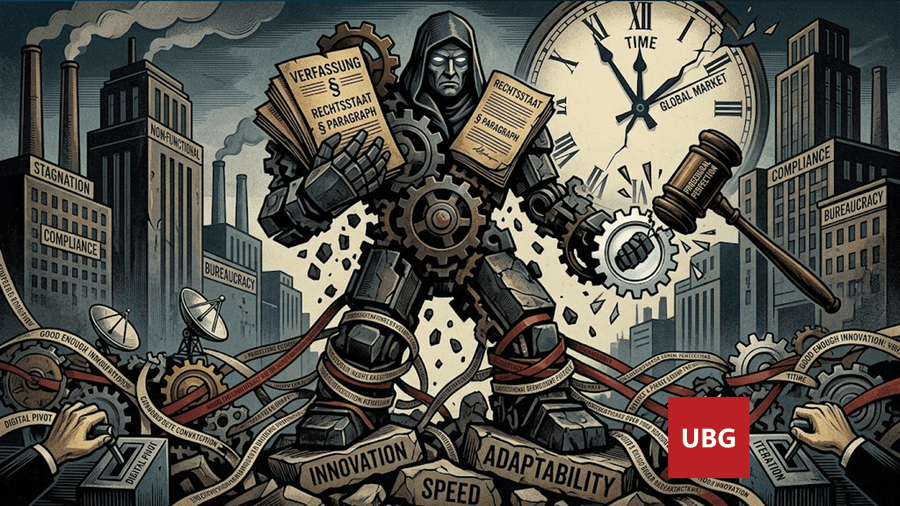
Across Western democracies—most acutely demonstrated by the structural stagnation of post-industrial Europe—a silent institutional ideology has taken hold: Verfassungsfetischismus, or Constitutional Fetishism.
Constitutional fetishism is not the healthy rule of law. The rule of law provides clear, simple, predictable legal guardrails within which human agency, economic dynamism, and technological experimentation can flourish.Constitutional fetishism, by contrast, transforms the law from a set of outer boundary markers into a totalizing, micro-managed blueprint for human behavior and state policy.
It is the belief that every complex real-world problem—from energy shocks and software revolutions to demographic decline—can be legislated away if only a nation drafts a precise enough statute, enforces a strict enough compliance framework, or enshrines a rigid enough fiscal rule into its basic law.
In treating the law as a secular religion rather than a pragmatic tool, nations are paralyzing their capacity to survive an fast-changing, software-defined world.
The Core Mechanics: Process Over Outcome
The defining trait of Verfassungsfetischismus is the total inversion of priority: the correctness of legal procedure takes precedence over the reality of the outcome.
[ THE PRAGMATIC STATE ]                         [ THE FETISHIZED STATE ]
Rule of Law = Simple Boundary Markers          Rule of Law = Totalizing Blueprint
"Everything is permitted unless forbidden."    "Everything is regulated until certified."
─────────────────────────────────────────      ──────────────────────────────────────────
• Prioritizes real-world yield & momentum      • Prioritizes procedural perfection
• Accepts dynamic risk and iteration            • Obsessed with zero-risk compliance
• Adapts policy when reality shifts            • Legislegates reality to fit the code
In a pragmatic state, the law answers a basic question: “Did this action violate fundamental rights or break explicit rules?” If the answer is no, human beings and market actors are free to build, test, fail, and iterate at maximum speed.
Under constitutional fetishism, the state operates under a dark presumption of distrust. Every new technology,infrastructure project, or business model is treated as guilty of risk until proven innocent by a dozen regulatory bodies.
If a policy destroys a domestic industry, locks an economy out of digital platforms, or leaves physical infrastructure to crumble, the fetishized system deems the outcome a success—so long as every paragraph of administrative law,environmental impact assessment, and court precedent was observed to the letter.
Case Study in Paralysis: The Fiscal Debt Brake
Nothing illustrates the destructive reality of constitutional fetishism better than Germany’s Schuldenbremse (Debt Brake), enshrined directly into its Basic Law (Grundgesetz) in 2009.
In a dynamic global economy, fiscal policy is a practical instrument—a dial to be adjusted based on capital yield,technological transitions, and long-term infrastructure needs. But under the spell of constitutional fetishism, fiscal prudence was elevated into a moral commandment and carved into stone.
[ CONSTITUTIONAL DEBT BRAKE (SCHULDENBREMSE) ]
                        │
                        ▼
┌─────────────────────────────────────────────────────────────┐
│  Legally Pristine State Balance Sheet                       │
│  • 0% Net New Borrowing                                     │
└───────────────────────┬─────────────────────────────────────┘
                        │
                        ▼
┌─────────────────────────────────────────────────────────────┐
│  Real-World Structural Consequences                         │
│  • Crumbling Bridges, Rails, & Physical Energy Infrastructure│
│  • Zero Capital allocated to Sovereign Cloud & Silicon Fabs │
│  • Massive Unrecoverable Opportunity Costs                  │
└─────────────────────────────────────────────────────────────┘
The real-world result? A nation with an immaculate, legally compliant balance sheet paired with decaying rail lines,failing schools, an energy-starved manufacturing base, and virtually zero sovereign digital stack.
When a state worships the legal purity of a rule over the physical and digital reality of its economy, it trades long-term systemic survival for short-term legal validation.Regulating What You Cannot Build
When an economy under the grip of constitutional fetishism loses the capacity to innovate in software, silicon engines,or energy, its institutional reflex is to deploy its only remaining muscle: bureaucratic regulation.
This manifests as the illusion that writing a law about a technological frontier is equivalent to owning that frontier.
| Region / Model | Primary Operational Reflex | Output / Primary Deliverable |
|---|---|---|
| United States | “If it works, scale it globally.” | Windows, iOS, Android, Cloud, AI Models |
| China | “If it works, speed it up & lower the cost.” | EVs, Battery Stacks, Solar Grid, Hardware |
| Fetishized Legal States | “If it works, regulate and certify it.” | GDPR, EU AI Act, Corporate Due Diligence Laws |
When a society produces thousands of pages of compliance directives for artificial intelligence, data privacy, and digital networks without producing a single world-class sovereign platform, it has substituted legal governance for real-world execution.
A startup or industrial firm operating inside a fetishized state spends more time and capital paying legal, environmental,and compliance consultants to ensure zero procedural defect than it spends building, shipping, and iterating actual products.
4. The Human Cost: The Loss of the “Good Enough” Baseline
The damage of constitutional fetishism is not confined to corporate boardrooms or high court rulings—it poisons individual human agency and societal speed.
For an individual, the ultimate rule of pragmatic freedom is simple: “As long as I don’t break laws, I am good.” This principle recognizes the law as an outer boundary marker, leaving the vast interior space wide open for experimentation, iteration, and movement.
Constitutional fetishism reverses this logic. It creates a culture where every action requires pre-approval, every risk must be insured against, and every human mistake is treated as a systemic failure.
Speed Beats Over-Engineering: In modern software, biology, and geopolitics, speed and iteration beat static perfection every time. Shipping a “90% perfect” product and upgrading it continuously via real-world feedback captures markets.
The Perfection Trap: Constitutional fetishism paralyzes societies because it refuses to launch, build, or deploy anything that carries an ounce of risk or imperfection.
The Path Forward: Restoring Law as a Tool, Not a Religion
Constitutional fetishism promises absolute certainty, zero risk, and perfect order. In reality, it delivers state paralysis,economic obsolescence, and extreme vulnerability to external shocks.
Nations seeking to survive the coming decades must break the spell of procedural worshipping:
Law as Boundary, Not Blueprint
Re-establish the law as simple, predictable guardrails designed to prevent harm, rather than a totalizing blueprint meant to micro-manage economic development and technological adoption.
Prioritize Yield and Execution Over Procedure
Rebalance administrative courts and regulatory bodies so that the cost of inaction and delay is weighed equally against the risk of action.
Embrace “Good Enough” Iteration
Shift institutional culture away from the fear of shipping imperfect systems. Accept that managing dynamic, real-world complexity requires constant, imperfect, rapid adaptation—not static legal perfection.
A constitution should be a shield that protects human freedom and a springboard for national capability. The moment a society turns its legal frameworks into an unalterable altar, it guarantees that when reality shifts, its perfectly documented, legally compliant institutions will be left behind by a world that chose to build.