The Standardized Soul: The Ontological Errors of Modern Psychotherapy
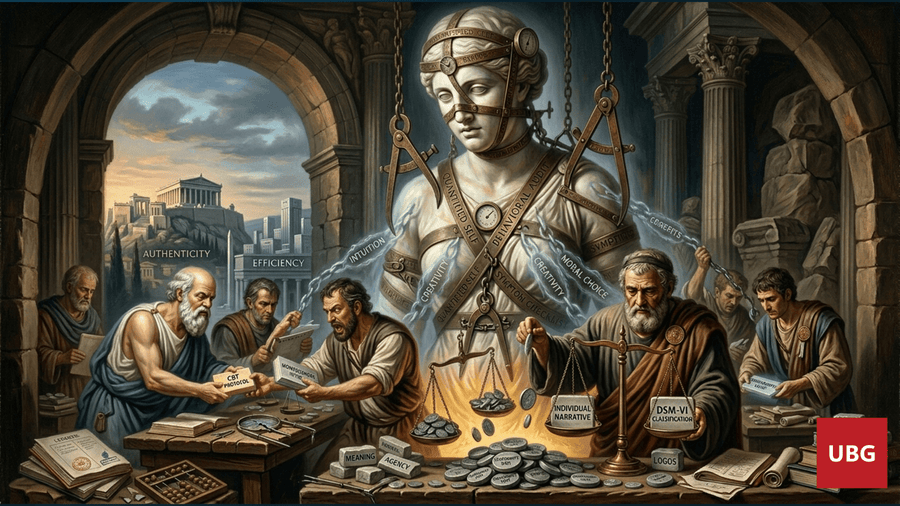
If modern neuroscience suffers from a crisis of ontological definition, modern psychotherapy suffers from a crisis of contextual reductionism. While the former misidentifies the brain as the mind, the latter increasingly treats the “Self” as a medical entity—a collection of symptoms to be “managed” rather than a narrative to be understood. This paper argues that the widespread adoption of the medical model, driven by the fetishization of manualized, evidence-based protocols, obscures the inherently existential nature of human suffering. By collapsing the distinction between pathological dysfunction and meaningful response, the therapeutic industry risks pathologizing the human condition and stripping patients of their agency. The result is a clinical landscape that optimizes for “functioning” within a systemic status quo, while often failing to facilitate genuine transformation.
The Medicalization of Malaise
The foundational ontological error of contemporary therapy is the assumption that psychological distress is, by definition, a defect of the internal system—a “disorder” analogous to a physical illness. This medicalization transforms human suffering from a phenomenon to be explored into a set of pathologies to be cured.
When a patient presents with “anxiety” or “depressive symptoms,” the clinical framework often pivots immediately to symptom reduction through standardized protocols. This neglects the possibility that such feelings may not be malfunctions at all, but rather rational, albeit painful, responses to unlivable circumstances. By treating the individual’s environment as a constant and their internal response as the variable to be fixed, therapy inadvertently serves as a form of social containment, teaching the individual to endure the unendurable rather than addressing the context that necessitates the distress.
The Fallacy of Manualized Uniformity
The push for “Evidence-Based Practice” (EBP) has introduced a profound epistemological tension. While Randomized Controlled Trials (RCTs) are essential for assessing specific interventions, their elevation to the “gold standard” of therapeutic truth forces the clinic to privilege nomothetic data (the average outcome of a group) over idiographic reality (the unique, contingent truth of the individual).
This “manualization” of care encourages a conveyor-belt approach to the soul. When therapy is reduced to a series of steps prescribed by a manual, the therapeutic alliance—the actual engine of change—is demoted from a primary human encounter to a secondary delivery mechanism. The clinical encounter becomes a space where the therapist observes the patient through the narrow aperture of a diagnostic rubric, often ignoring aspects of the patient’s life that do not fit neatly into the provided taxonomy.
The Epistemic Injustice of Diagnostic Labels
In the clinical setting, the DSM is often wielded as an objective map of the mind. However, it is an ontological commitment disguised as a neutral tool. When a therapist applies a diagnostic label, they are not merely categorizing a patient; they are framing the patient’s self-interpretation.
This often leads to a form of hermeneutical injustice: the patient adopts the language of their diagnosis to describe their life, effectively closing off any narrative of their own experience that falls outside the diagnostic criteria. The “diagnosis” stops being a starting point for dialogue and becomes the boundary of the patient’s identity. The person is no longer a human in a world; they are a “Case of [Diagnosis] X.”
The Neoliberal Optimization Loop
Perhaps the most tragic aspect of modern psychotherapy is its shift toward the ethos of “self-optimization.” In a high-pressure, late-modern society, therapy is increasingly marketed as a way to “enhance” individual performance—to make the patient more resilient, more productive, and more “efficient.”
By focusing on internal resilience, the field often avoids questioning the external structures—such as precarious labor, eroded community ties, and relentless consumption—that produce the very “disorders” therapy claims to treat. When therapy is co-opted as a tool for sustaining the individual within a broken system, it ceases to be a liberatory practice and becomes a form of psychological regulation.
Toward a Recovery of Meaning
Modern psychotherapy is not a failed discipline, but it is a captured one. It possesses the most sophisticated tools for symptom management in history, yet it risks losing the very thing that makes therapy necessary: the capacity to help a person make sense of their existence.
To move forward, the field must re-engage with the existential and phenomenological dimensions of the Self. It must resist the urge to reduce the infinite complexity of human life to a series of diagnostic codes. If the task of the neuroscientist is to identify the physical basis of the mind, the task of the therapist should be to protect the sanctity of the human narrative. We must stop asking “how do I fix this machine?” and start asking “what does this life mean, and how can we live it more authentically?”