The Decolonization Myth: Subordinated Sovereignty and the Financialization of the Post-Colonial State
Abstract
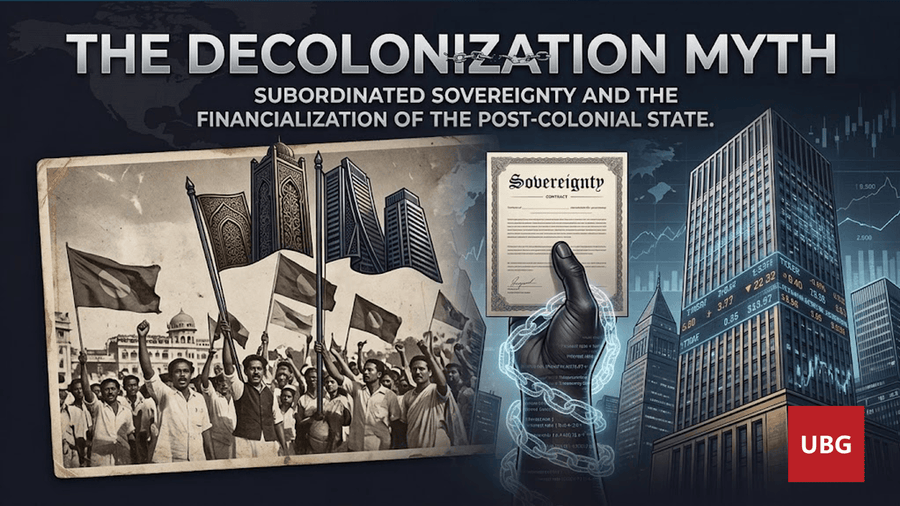
The mid-20th-century transition from direct colonial rule to independent statehood is conventionally historicized as a triumph of political liberation. This paper challenges that narrative through the lens of South Asian decolonization, arguing that the 1947 partition and independence of India and Pakistan—and the subsequent emergence of Bangladesh in 1971—represented a calculated balance-sheet restructuring by metropolitan powers. Faced with the soaring administrative, military, and social overhead of a destabilized subcontinent, the British Crown externalized its liabilities while preserving mechanisms for financial extraction. By granting formal de jure sovereignty, the imperial center engineered the legal prerequisite for neo-imperial control: the creation of sovereign debtors legally bound to international financial systems. Through successor state liabilities, sterling asset manipulation, and the imposition of multilateral conditionality, the classic empire did not dissolve; it financialized, leaving South Asia permanently entangled in structural debt traps.
I. Introduction: The Fiscal Crisis of the British Raj
By the conclusion of World War II, the British Raj—once the premier engine of global resource extraction—had transformed into a volatile, high-risk fiscal liability. Economically, Britain was functionally bankrupt, surviving on billions in wartime loans from the United States. In South Asia, the material overhead of maintaining physical containment was spiraling out of control. The British Treasury faced the dual shocks of an increasingly radicalized independence movement and widespread mutinies within the Royal Indian Navy and armed forces in 1946. Physical coercion had become too expensive, dangerous, and politically toxic for a war-weary British public to finance.
Faced with this overhead crisis, the British government executed a rapid political exit in August 1947. This was not a measured surrender of power, but a strategic corporate spin-off. By rushing the partition of the subcontinent into India and Pakistan, London achieved a massive externalization of social and administrative liabilities. The cataclysmic human and financial costs of partition—including massive refugee crises, communal violence, and fractured infrastructure—were instantly legally severed from the British Treasury. The newly manufactured independent states absorbed 100% of the risk, transforming a systemic imperial failure into the localized, “sovereign” responsibilities of New Delhi and Karachi.
II. The South Asian Precedent: From Corporate Buyouts to Successor Debt
The architecture of transferring imperial liabilities to South Asian populations has deep structural roots. When the British Crown took direct control of India from the East India Company following the 1857 Uprising, it executed one of the most predatory balance-sheet maneuvers in economic history.
[ East India Company Wars & Buyout Costs ]
                     │
                     ▼
[ British Crown Assumes Direct Control (1858) ]
                     │
                     ▼
[ Re-coded as "The Indian Public Debt" ] ──► Extracted from Indian taxpayers via land revenues
The Crown purchased the stock of the failing, private East India Company, paid out its wealthy shareholders, and then transferred the entire cost of the buyout as a public debt onto the Indian taxpayer. For the next ninety years, Indian land revenue and labor were extracted to service this artificial debt, funding British military campaigns as far away as Africa and China.
By the time of the 1947 transition, this extraction model was modernized through the manipulation of Sterling Balances. During World War II, Britain forced India to provide vast amounts of raw materials and military services on credit. This created a massive debt owed by Britain to India, held in British pounds (sterling) in London banks.
Instead of paying this debt out upon independence, Britain locked it down. Under the terms of the financial separation, India and Pakistan were severely restricted in how they could draw down their own sterling reserves. They were forced to keep their wealth tied to the British financial system, preserve British corporate assets, and honor sterling-denominated obligations, effectively turning their hard-earned wartime surpluses into a mechanism to stabilize the collapsing British domestic economy.
III. The Multilateral Security Force: South Asia and the IMF Trap
Under classical imperialism, if a South Asian territory resisted extraction, the empire deployed troops. In the post-colonial era, physical gunboats were replaced by the bloodless enforcement of multilateral financial institutions, specifically the International Monetary Fund (IMF) and the World Bank. Because the colonial border-drawing of partition left South Asian nations with deeply asymmetrical trade balances, severe infrastructure deficits, and structurally induced poverty, they were systematically funneled into the global lender matrix.
The enforcement mechanism of this neo-imperial financial architecture operated across the subcontinent through distinct structural traps:
- The Pakistan Continuum: Pakistan entered its first IMF program as early as 1958. Over the subsequent decades, it became trapped in a chronic dependency loop, entering over twenty separate IMF arrangements. To secure rolling credit lines, Islamabad was repeatedly forced to slash social expenditures, effectively dismantling public infrastructure while prioritizing external debt servicing and internal military overhead.
- The Indian Pivot: India managed to resist wholesale financial capitulation for decades through protectionist policies, until its severe balance-of-payments crisis in 1991. Facing total depletion of its foreign reserves, New Delhi was forced to physically airlift its gold reserves to London and Zurich as collateral. The subsequent IMF bailout forced a sweeping structural opening of the Indian economy, privatizing state assets and granting Western capital unprecedented access to domestic markets.
- The Bangladesh Double-Extraction: Bangladesh provides the starkest illustration of the sovereign debtor trap through “double decolonization.” Emerging from a cataclysmic war of liberation in 1971, the nation suffered under a system of internal colonialism where West Pakistan had systematically extracted East Bengal’s jute revenues to finance its own industrialization. Left with a completely devastated infrastructure and facing a massive famine in 1974, the newly sovereign state was denied critical international aid until it capitulated to global financial networks. Bangladesh was forced to enter its first IMF structural adjustments by the late 1970s. Under these mandates, the state was compelled to dismantle its public distribution systems, privatize its nationalized jute mills, and orient its entire labor force toward low-value garment exports to earn the hard currency required to service foreign loans.
When these nations applied for emergency credit, the global financial system imposed strict macroeconomic conditionalities through Structural Adjustment Programs (SAPs). India, Pakistan, and Bangladesh were all forced to devalue their currencies, slash public subsidies on agriculture, electricity, and fuel, and pivot their economies toward cash-earning exports rather than domestic self-sufficiency.
Crucially, the physical enforcement of these deeply unpopular austerity measures was offloaded to the local state apparatus. The former colonial state machinery—the bureaucracy, paramilitary forces, and judicial systems left behind by British rule—was deployed by local political elites to suppress domestic labor strikes, peasant rebellions, and public protests against IMF mandates. The international financial centers achieved absolute capital extraction while keeping their own hands entirely clean.
IV. Conclusion: Subordinated Sovereignty as the Ultimate Asset Class
The modern economic crises plaguing South Asia—from Pakistan’s chronic debt-servicing loops to Sri Lanka’s catastrophic sovereign default in 2022—are not isolated incidents of local mismanagement. They are the systemic, predictable outcomes of a global financial architecture designed around the myth of decolonization.
The core delusion of South Asian independence lies in the conflation of de jure political sovereignty (the flag, the constitution, the UN seat) with de facto economic autonomy. True sovereignty requires absolute control over monetary policy, resource extraction, and domestic capital accumulation. By upgrading the territories of the British Raj into “sovereign nations,” the global financial system created legally binding entities capable of signing predatory loan agreements and being sued in international financial courts—actions a colony could never legally perform.
The British Empire did not dissolve in 1947; it simply modernized its ledger. Controlling the economies of India, Pakistan, and Bangladesh from financial high-rises in London, New York, or Washington D.C. has proven infinitely cheaper, safer, and more permanently profitable than patrolling the streets of Calcutta, Karachi, or Dhaka with soldiers. Modern decolonization did not break the chains of empire; it merely converted them into interest rates.