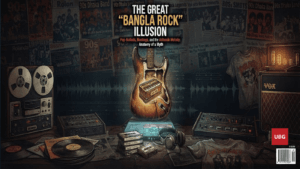
The Great “Bangla Rock” Illusion: How Pop-Ballads, Bootlegs, and Adhunik Melodies Were Sold as a Rock Revolution
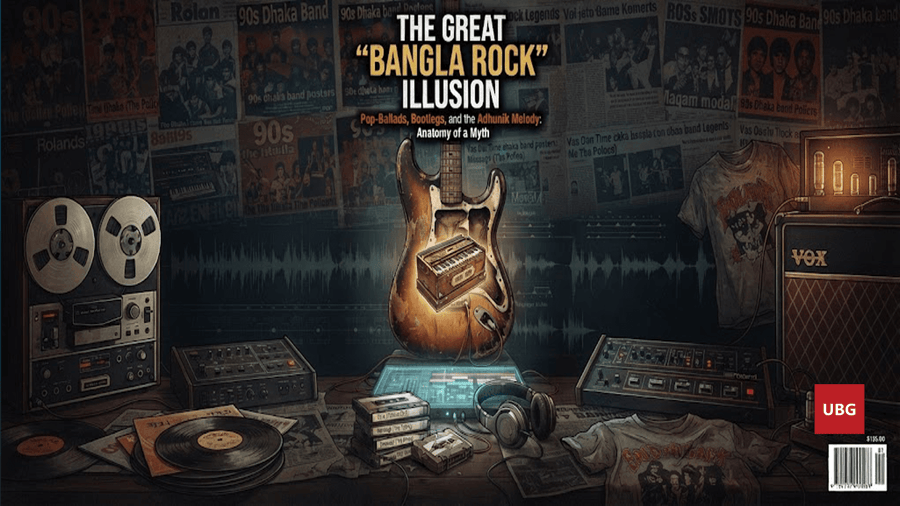
For decades, the cultural narrative across Bengal has treated the mainstream “band music” movement of Dhaka as a golden era of uncompromising rock and heavy metal rebellion. We are told tales of legendary pioneers who supposedly broke mold and forged a heavy underground sound.
But if you strip away the nostalgia, turn off the marketing machinery, and look at the music through an analytical lens—examining audio engineering, music theory, and global comparative history—the myth collapses.
The uncomfortable truth is this: What the Dhaka mainstream calls “Bangla Rock” and “Heavy Metal” is essentially traditional Bengali Adhunik and soft-pop music wearing borrowed Western clothes.
The melody was never Western. The compositions were rarely original. And the “rebellion” was nothing more than safe, middle-class sentimentality played through a distortion pedal.
The Ballad Trap: Ayub Bachchu, LRB, and the Blues Myth
The late Ayub Bachchu is universally worshiped as the ultimate guitar god of Bangladesh, and LRB is routinely credited with pioneering “blues-rock.” But if you subject their catalog to basic structural analysis, the claim evaporates.
Where is the 12-Bar Blues? True blues-rock relies on the 12-bar blues progression, dominant sevenths, and a swinging triplet shuffle groove. Look at landmark LRB anthems like Sei Tumi or Meye. They do not use blues changes. They are cyclical, standard pop-ballad chord loops.
The Guitar Solo as a Mask: Bachchu could certainly rip through a minor-pentatonic scale, but taking a neo-classical or shred-style solo over a soft-pop progression does not make a song a blues-rock track.
The Vocal Delivery: Beneath the Marshall stacks, the actual vocal melodies of tracks like Madhobi are rooted in traditional Bengali vocal ornamentations—meend and gamaka—mirroring classic Adhunik structures rather than raw, blues-driven vocal projection.
Miles and Feedback: New Wave Clones and “Take On Me” Chords
If LRB hid pop ballads behind a guitar hero veneer, bands like Miles and Feedback exposed an even deeper layer of derivation.
Miles was marketed as a stadium rock band, but musically they functioned as an 80s Adult Contemporary soft-pop outfit. Their rhythm sections relied on synthetic drums and light pop-funk grooves, while their vocalists delivered pristine, polite love songs using the exact emotional posture of traditional Adhunik crooners.
Feedback took it a step further into outright structural appropriation:
Tracks like Chokh on the landmark album Ullash didn’t just take inspiration from Western synth-pop; they mirrored the harmonic progression and synth architecture of global 80s hits like Culture Club’s Time (Clock of the Heart).
In many instances across the 80s and 90s scene, isolation from global copyright enforcement allowed bands to take foreign instrumental beds, strip the original English vocals, and drop local lyrics over them. It wasn’t organic composition—it was a high-end import-and-repackage operation.
The “NYC Producer” and Bootleg Loops: Fuad Al Muqtader
When the scene stagnated, the arrival of producers like Fuad Al Muqtader was hailed as a high-tech revolution straight out of New York City. But digital transparency has exposed how much of that “genius” relied on collage work rather than native creation.
Instead of writing original grooves or building heavy, complex compositions from scratch, these modern tracks frequently relied on uncredited samples and bootleg loops lifted directly from legendary Western acts—including pillaging drum breaks and guitar intros from bands like The Police (such as motifs from Message in a Bottle). Dressing up digital remixes with a computer workstation doesn’t make you a rock pioneer; it makes you a digital adapter of pre-existing Western arrangements.
The Latin Jazz Borrowing of Bappa Mazumder
Even when looking at artists praised for their classical pedigree and acoustic songwriting, like Bappa Mazumder (Dalchhut), the veneer of pure, native composition cracks. Much of their sophisticated, romantic output relies heavily on uncredited translations of Latin cool jazz, bossa nova, and Spanish-infused acoustic standards.
Because local audiences had little access to global jazz archives, complex nylon-string bossa nova chord progressions were easily rebranded as the spontaneous, classical-fusion genius of homegrown romantic pop.
The Missed Opportunity: What “Bangla Rock” Could Have Been
The greatest tragedy of the Dhaka-centric commercial scene is not just that it relied on imitation and soft-pop formulas—it is that it completely missed the bridge to a truly authentic modal and heavy music identity.
Look at countries like Turkey, where artists forged Anatolian Rock. They took Western rock instrumentation and organically fused it with native microtonal scales, folk roots, and West Asian modal structures.
In our own history, the national poet Kazi Nazrul Islam effortlessly synthesized Ottoman, Persian, and Arabic modal frameworks with indigenous Bengali rhythms to create revolutionary, heavy, and structurally profound art (Nazrul Geeti).
Yet, the mainstream band scene chose the lazy path: copying British New Wave synth-pop, stealing guitar riffs, and turning out safe, middle-class romantic ballads. They wanted the aesthetic of rebellion without doing the heavy lifting of building a genuine, culturally rooted musical architecture.
The Ultimate Reality
The mainstream “golden era” of Bangla rock was a masterclass in marketing. By pairing Western equipment with traditional Adhunik melodies, and shielding their compositions behind foreign loops, jazz progressions, and bootlegged synth lines, they created a comfortable echo chamber.
It was never a raw, heavy rock revolution. It was pop music in a leather jacket. And once you hear the blueprints, you can never unhear the illusion.